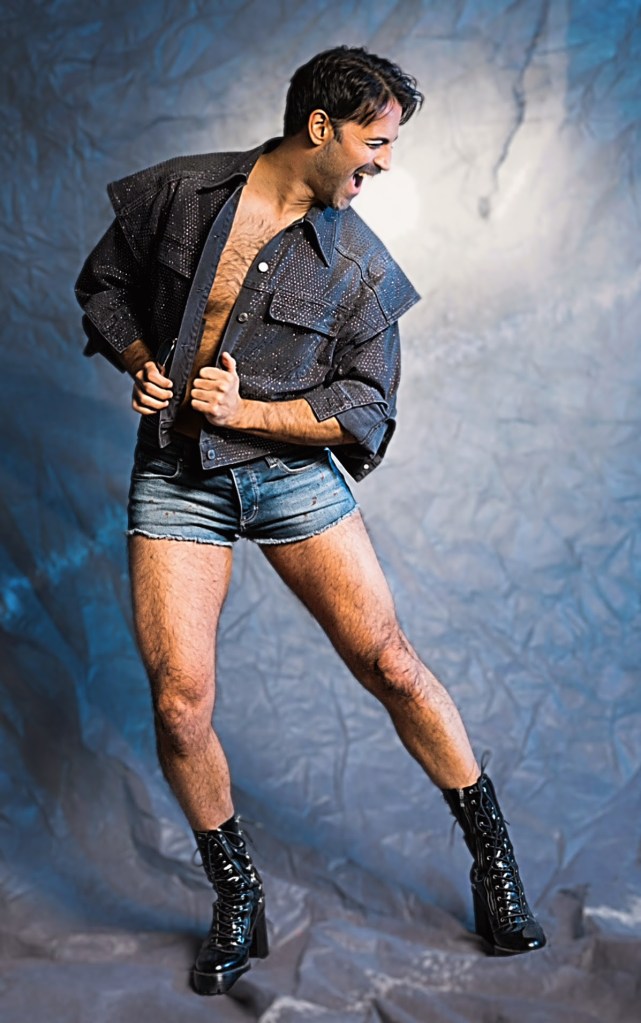
Toronto-based indie pop artist Aman Dhesi announces the release of his debut album The Restless Night, out today via Zedd Records, alongside the album’s opening statement, the lead single “Dancefloor Shoes.” Produced by Mark Zubek and Dhesi himself, the track arrives as a shimmering, propulsive declaration of self-liberation — a dance-floor ready anthem designed to move bodies and spirits in equal measure. With its pulsing synth architecture and irresistible Saturday-night energy, “Dancefloor Shoes” signals the full arrival of one of independent pop’s most compelling new voices.
Originally from North Delta, B.C. — a suburb nestled in the Lower Mainland outside Vancouver — Dhesi has built a distinctive sonic identity across years of dedicated craft and community. His 2019 debut EP Day One introduced defining tracks “Another Never Ever” and “Rise Up,” establishing a sound rooted in club intensity and confessional honesty. Since then, he has earned multiple #1 placements on independent queer music charts while cementing his reputation as a dynamic live performer across Toronto’s vibrant music landscape. The Restless Night is his boldest and most fully realised vision yet.
“Dancefloor Shoes” opens with an invitation and accelerates into pure communion. The song’s narrator slips on those shiny black leather soles and steps into a world of possibility, arriving fully present to claim the night. As Dhesi writes in the chorus: “I got my dancefloor shoes / Feelin’ in the mood / Jeans huggin’ tight / C’mon grab that mic.” The lyric is deceptively simple — joyful, stylish, and completely alive — yet it carries the weight of someone choosing to show up wholly and openly for the first time. By the time Dhesi sings “I just wanna’ be free tonight,” the desire has transcended the dancefloor entirely.
The album from which the single is drawn was born during a period of profound personal transformation for Dhesi. Writing and producing through the clarity of newfound sobriety, he channelled a heightened awareness of self into every track. “There’s a strange clarity that comes with sobriety,” Dhesi reflects. “You’re no longer numbing the chaos — you’re standing inside it, fully awake.” That lucidity courses through “Dancefloor Shoes,” elevating what could be a conventional club track into something far more intentional: a portrait of radical presence, of seeking freedom on your own terms, with nothing dulling the senses or softening the feeling.
Crafted alongside producer Mark Zubek, the sonic palette of “Dancefloor Shoes” draws from the glistening synth textures of 80s-inspired production while surging forward with the kineticism of contemporary dance-pop. The result is a cinematic, after-dark sound that feels both nostalgic and immediately of the moment — strobe lights and slow dancing rendered in shimmering electronic detail. As an openly gay South-Asian and Sikh man and proud member of the BIPOC and LGBTQIA+ community, Dhesi brings a perspective that is urgently needed within the Canadian indie pop landscape: one where queer nightlife, desire, and emotional release are rendered with full artistic seriousness and celebratory beauty.
You’ve described The Restless Night as an album about learning how to exist inside the night rather than escaping it. For many in the queer community, the nightlife is a sanctuary. How did your relationship with that space change while writing this album?
I think before making “The Restless Night”, I experienced queer nightlife the way a lot of us do, as an escape. It was where I could go to feel free, to feel desired, to step into a version of myself that didn’t feel edited. But while writing this album, my relationship to it deepened. I started to understand that it’s not just escape, it’s inheritance.
When I’m out dancing now, especially in a space full of queer people, it doesn’t just feel like a night out. It feels like I’m tapping into something much older than me, a lineage. Our elders protested during the day, and at night, they danced. They turned the dancefloor into a space of liberation, connection and survival.
I also like to think that there’s a kind of beautiful restlessness that runs through queer culture. I mean that in the best way. We love hard, we feel deeply, we have this almost rebellious need to live as our most authentic selves and historically the only place we could fully express that was at night, on the dance floor together.
That realization changed everything for me as a songwriter. I wasn’t just writing songs about going out, I was writing about why that space matters. Why it still matters.
That’s why the album opens the way it does. That feeling of getting ready, putting on your “dancefloor shoes”, locking eyes with someone, feeling that surge of joy, desire, and possibility, that’s not trivial. That’s sacred in its own way.
So “The Restless Night” became less about escaping into the night, and more about learning how to exist inside it. To understand it as a space of history, of community and of unfiltered self-expression.
“Dancefloor Shoes” feels like a manifesto for self-liberation. Can you tell us about the moment you “slipped on those shiny black leather soles” in real life and felt truly ready to claim your space?
I don’t think there was just one moment where I “put on the shoes” and everything changed. It was more of a shift for me.
For a long time, I moved through queer spaces with a bit of hesitation, always aware of how I was being perceived, holding parts of myself back, trying to fit into what I thought I was supposed to be.
But after getting sober, something really flipped. I remember being out in Toronto, on a packed dance floor, and instead of looking around for validation or trying to be seen a certain way, I just…let go.
I stopped performing for the room and started actually inhabiting my body. Dancing the way I wanted to dance. Making eye contact without overthinking it. Letting myself feel confident, sensual, even a little dangerous.
That’s what “Dancefloor Shoes” really represents to me. It’s not about the shoes themselves, it’s about that internal shift where you decide, “I’m not shrinking anymore. I”m not editing myself for anyone in this room” and it becomes a metaphor for life. I think a lot of queer people can relate to that feeling of having to tone themselves down in everyday life. So the dancefloor becomes this space where those hidden parts finally get to come forward. In that sense, the song is almost a celebration of that release.
So when I sing about putting on those shiny black leather soles, it’s symbolic. It’s that moment of stepping into your full self and claiming your space, not by asking for permission, but by just being undeniable.
The album blends 80s synth textures with modern dance-pop. Who are the queer icons or musical pioneers that paved the way for the shimmering, cinematic sound you and Mark Zubek created?
First, I have to give a shout out to my producer, Mark Zubek. I often describe him as the end to all my musical sentences. He was my partner in shaping the sonic world of “The Restless Night”, and the chemistry we built in the studio is a big part of why the album sounds the way it does. There’s a real trust and shared language there that allowed us to push things into something cinematic and cohesive.
In terms of influence, Madonna is a foundational reference for me. There’s a reason why she’s such a queer icon, especially in her imperial era, there was this sense of defiance and total self-determination in her sound and image. That unapologetic energy really informed how I approached this album.
Janet Jackson is another huge one. She built the architecture of modern dance pop. When I think about albums like “Rhythm Nation”, I think about scale, something that feels precise, emotional, but also larger than life. That sense of sleekness and cinematic control was something I really wanted to tap into.
George Michael is also essential for me, particularly as a songwriter. His ability to craft pop songs that feel both intimate and expansive is something I studied closely. There’s definitely a bit of that DNA in “Dancefloor Shoes”.
Beyond that, my influences aren’t just musical, they’re cultural and cinematic. I grew up in the 90s and early 2000s, so artists like New Order, and even electronic acts like Underworld, shaped my sense of atmosphere. There’s also a strong visual influence running through the album, from the 80s, films like “Cruising”, tech-noir aesthetics, even darker industrial textures inspired by Nine Inch Nails. Those elements helped build the world around the songs.
So the sound of “The Restless Night” really comes from that intersection, queer pop lineage, dancefloor culture and cinematic storytelling filtered through a millennial lens. It’s less about recreating a specific era, and more about pulling from all of those influences to create something that feels both nostalgic and new.
You included a cover of Belinda Carlisle’s “Mad About You.” What is it about that specific track that resonates with your journey, and how did you put the “Dhesi” spin on it?
I’ve always loved Belinda Carlisle. When I think of 80s pop-rock, she represents this very specific kind of sunlit open-hearted energy. And “Mad About You” has always stood out to me because at its core, it’s just an unabashed declaration of love.
What really resonates with me is how earnest it is. We live in a time where being too sincere or wearing your heart on your sleeve can be seen as “cringe”, but I come from an era, and a musical lineage, where that kind of emotional openness was celebrated. I wanted to reclaim that feeling.
Our approach was to keep the spirit of the original intact, but reimagine it for the world of “The Restless Night”. We replaced the pop-rock framework with a pulsing, modern club rhythm, and built a more expansive, cinematic atmosphere around it. There’s also a layered, almost hymn-like vocal element running through the track that gives it a slightly more global, immersive feel.
Where it sits on the album is really important too. By that point in the album, you’ve moved through defiance, darkness, vulnerability, and healing. So “Mad About You” becomes this moment of release, where all the armour drops, and what’s left is just openness, joy, and the willingness to love again.
In that sense, the Dhesi spin isn’t just sonic, it’s emotional. It’s about taking a classic and placing it within a journey that moves from guarded to fully open.
You mentioned that sobriety brought a “strange clarity” to your creative process. How did being “fully awake” change the way you write about topics like eroticism and desire compared to your earlier work?
The simplest way to put it is, I got honest.
This album was written during the same period that I was getting sober, and with that came a kind of clarity I hadn’t experienced before. A lot of emotions that I had either been avoiding, numbing, or keeping buried suddenly came to the surface, and I didn’t really have a choice but to confront them.
Before that, I think I often wrote from a place of performance, trying to prove something or hoping people would respond to the songs in a certain way. Even when I was being personal, I wasn’t always going all the way there.
Sobriety stripped that away. It forced me to sit with myself and actually feels things as they were, without distraction. And that changed how I approached everything, especially topics like eroticism and desire.
There’s a lot of shame that can come with that, particularly as a gay man. And I realized I had never fully written from a place that acknowledged both the sensual and the emotional truth of my experiences. Songs like “Renegade Kiss” or “Dance or Die” come from that shift – there’s a level of defiance and ownership there that I don’t think I would have accessed if I wasn’t sober.
So the clarity wasn’t just about being more focused, it was about being more willing to tell the truth. And once I allowed myself to do that, the writing became less about how something might be received, and more about expressing something real.
From your 2019 EP Day One to this debut album, your sound has moved from “club intensity” to “confessional honesty.” Do you feel that honesty is easier to achieve now that you are creating from a place of newfound sobriety?
I’m really proud of “Day One”. It was exactly what it needed to be, a starting point. It introduced my instincts as a singer and songwriter, and it leaned heavily into that club energy, which has always been a big part of who I am.
With “The Restless Night”, there’s definitely been an evolution. The club intensity is still there, but it’s sitting alongside something much more confessional and emotionally direct.
I wouldn’t necessarily say honesty has become easier but it’s become harder to avoid. Sobriety has taken away a lot of the ways I used to distract myself or stay on the surface. I’ve had to sit with my thoughts and emotions as they are, and that naturally shows up in the writing.
So instead of trying to shape songs around how they might be received, I’m starting from a more truthful place and letting the song follow that. There’s still uncertainty in that process, I don’t have everything figured out, but I”m less afraid of going there now.
In a way, that ties back to the idea of “The Restless Night”. There’s a constant searching in me, and sobriety has made me more willing to tap into that, whether it leads somewhere uncomfortable or somewhere beautiful.
As an openly gay South Asian and Sikh man, you occupy a space that is often underrepresented in Canadian indie pop. How does your heritage inform the nocturnal journey of this album?
I’m very aware that I occupy a space that isn’t widely represented, being openly gay, South Asian, and Sikh in this genre, and I don’t take that lightly. It’s something I’ve thought about a lot, especially through this album cycle.
At the same time, I want to be honest about the fact that my relationship to my heritage is complicated. I didn’t grow up feeling deeply connected to it in a traditional sense. A lot of my formative years were shaped by trying to fit into environments where I felt different, and I learned to compartmentalize parts of myself in order to do that, to leave certain parts at home so I could move through the world more easily. That creates a certain kind of tension over time, between how you’re seen and how you’ve learned to see yourself. And I think I’m still unpacking that in my own way.
But regardless of that complexity, I do recognize that I am visible in that space. And I think about that a lot, especially when I think back to being a closeted queer kid. If I had seen someone who looked like me, who shared even part of my background, living out loud, being bold, being expressive, being unapologetic in their art….that would have meant everything to me.
So if I can be that for someone else, even in a small way, that’s something I don’t take lightly, and I’m proud to stand in that.
In terms of how that informs “The Restless Night”, I think it shows up more emotionally than explicitly. The album is really about searching for belonging, moving through desire, identity, vulnerability, and trying to find a place where you can exist fully. And I think that feeling of being both inside and outside of different worlds is something I’ve lived with for a long time.
That’s why spaces like queer nightlife feel so important to me. They are places where you can construct your own sense of belonging, where you don’t have to explain yourself in the same way. And that idea, of carving out space for yourself when you haven’t always felt like you fit elsewhere, is very much at the heart of this album.
So even if my heritage doesn’t show up in a traditional or overt way in the music, it’s still part of the lens I see the world through. It informs that sense of restlessness, that searching, that desire to find connection and freedom. And that, to me, is what “The Restless Night” is all about.
Your press release mentions the “extraordinary courage” it takes to inhabit one’s life without armour. What message do you hope young BIPOC queer artists take away from seeing you step fully into your power with this release?
I always come back to this idea that the most powerful thing artists can give each other isn’t inspiration, it’s permission. A queer writer named Leo Herrera said that.
For most of my life, I had a version of myself in my head that was bolder, louder, and more honest thatn the person I was actually letting the world see. And it took me a long time, through a lot of fear, a lot of self-doubt, and honestly through getting sober, to finally stop editing myself down and just step into that version.
So if there’s one thing I hope young BIPOC queer artists take from this, it’s that you don’t have to wait until you feel ready, or perfect, or fully figured out. You’re allowed to take up space as you are, right now.
Putting this album out, for me, is less about arriving somewhere and more about deciding I’m not going to hide anymore. And if someone out there sees that and feels even a small shift, like maybe they can be a little louder, a little more honest, a little less afraid, then that means everything.
Because that’s how it works. Someone gives you permission, even unintentionally. And then you pass that on.
You have cemented a reputation as a dynamic performer in Toronto’s vibrant scene. When fans come to see The Restless Night performed live, what kind of atmosphere are you looking to cultivate?
When people come to see “The Restless Night” live, I want it to feel like stepping into the world of the album, something immersive, a little dangerous, a little seductive, but also deeply human.
A big part of what I’ve been working on, especially through my time with my live-performance coach is learning how to really embody each song rather that just sing it. So the show becomes a journey. There’s moments of bravado and swagger, but also moments where things strip back and get vulnerable and raw.
Visually, there’s a strong point of view too. I’m very inspired by queer nightlife, by leather culture, by that sense of rebellion and self-expression, so there’s an element of spectacle and character in how I present myself on stage. It’s not just about standing there and delivering songs, it’s about creating a feeling, a world that people can step into with me.
At the core of it though, I want people to feel free. Whether that’s feeling empowered, seen, turned on, emotional, whatever it is, I want it to feel like a space where you don’t have to hold anything back.
The album ends with an invitation for everyone to get their heels onto the dance floor. If you could curate the perfect “Restless Night” after-party, what three things, besides your shoes, would be mandatory?
A good mocktail because I want something in my hand while I’m making seductive eye contact across the room.
No small talk. If we’re here, we’re here to feel something and actually connect, not network.
A proper dance floor with a great sound system and a DJ who knows how to stretch a moment, give me an extended remix of “The Restless NIght” and let people lose themselves in it.
And a darkroom energy – low lights, a little mystery, that space where you catch someone’s eye and don’t have to say a word. Sometimes it leads somewhere, sometimes it doesn’t. But there’s something powerful about being able to drop the performance and just be. Instinct, connection, and nothing in the way.

