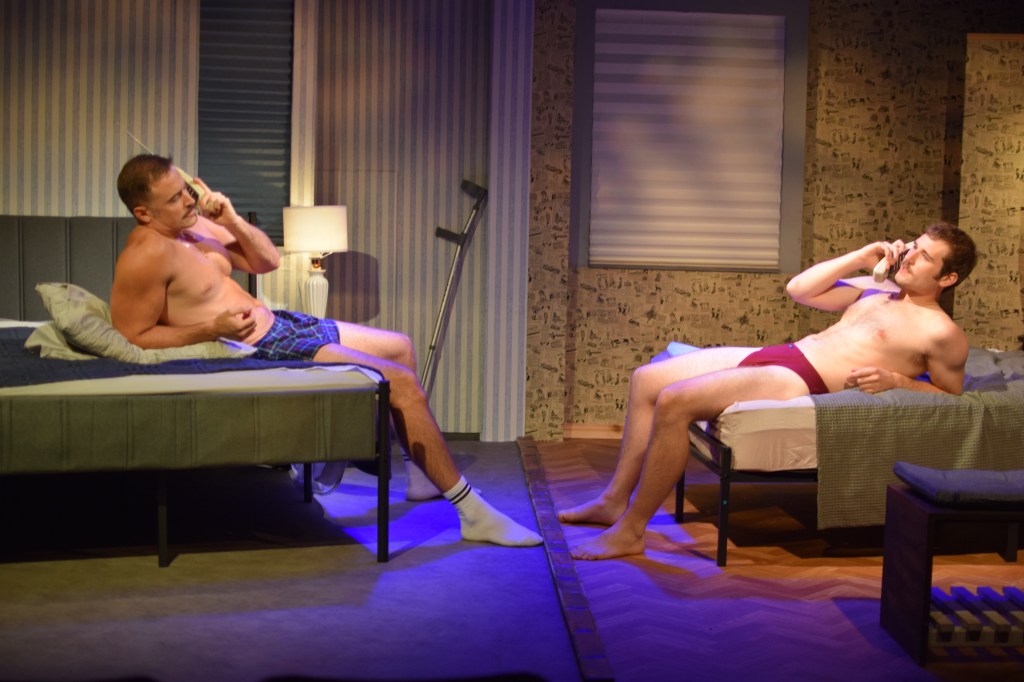
From the producer of F**king Men, Afterglow (2019), and Happy Ending comes Robert Chesley’s JERKER, a bold two-hander, making its highly anticipated Waterloo East Theatre premiere this Autumn, 40 year after its acclaimed premier in San Francisco.
JERKER is a daring and seductive two-person drama about two strangers who connect through a series of late-night phone calls. What begins as anonymous fantasy quickly sparks into something deeper.
Hidden from each other’s sight, the men reveal secrets, fears, and longings through nothing but their voices. Each call pulls them further into an intimate world where imagination becomes a lifeline, where the line between fantasy and genuine connection begins to blur, raising the question of who they really are to one another.
By turns playful, provocative, and unexpectedly tender, the play explores how intimacy can grow in isolation. It’s a steamy, suspenseful journey into desire, vulnerability, and the power of being heard.
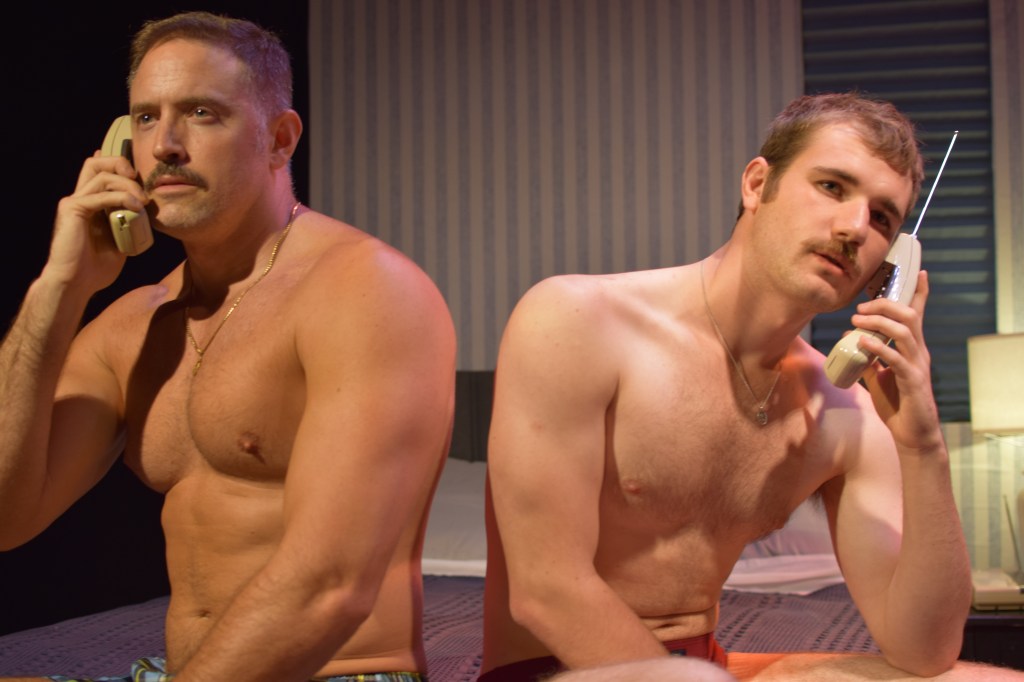
From the producer of F**king Men, Afterglow (2019), and Happy Ending comes the 40th anniversary production of Jerker, by Robert Chesley, alternatively titled The Helping Hand, A Pornographic Elegy with Redeeming Social Value and A Hymn to the Queer Men of San Francisco in Twenty Telephone Calls, Many of them Dirty, making its highly anticipated Waterloo East Theatre premiere this Autumn. The production has a limited 3-week run from 26 September until 18 October.
Playful, provocative, and unexpectedly tender, Jerker explores how intimacy can grow in isolation. It’s a steamy, suspenseful journey into desire, vulnerability, and the power of being heard.
YASS met the two protagonists, Paul Dennison and James Lee and here is everything you need to know.
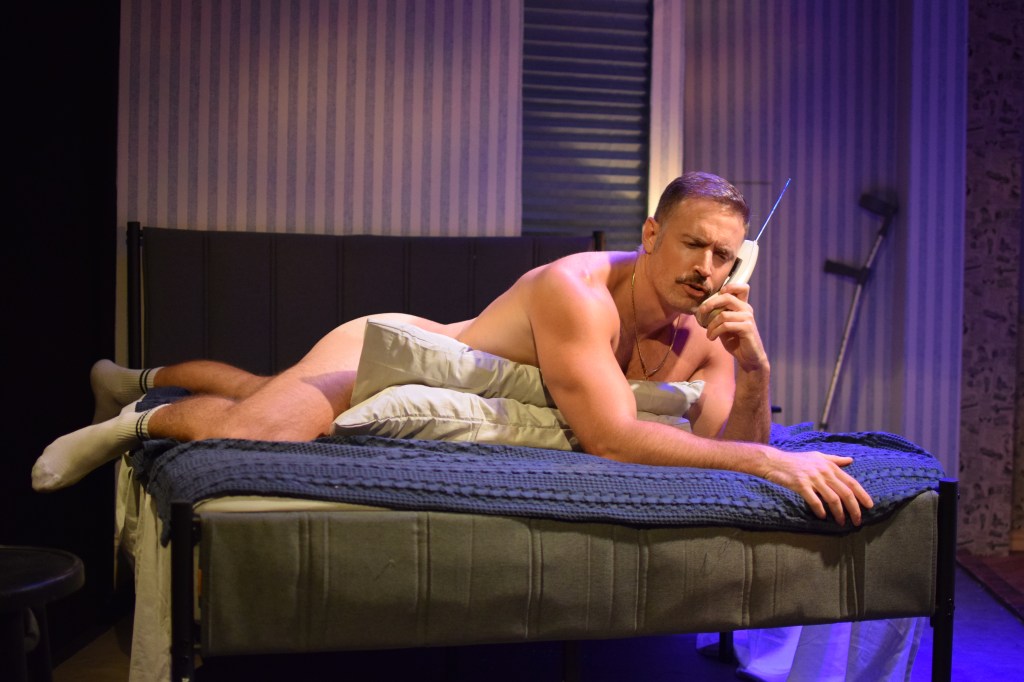
JERKER relies entirely on phone conversations between two men who never physically see one another. How do you and your co-star, James Lee (Bert), build dramatic intimacy and emotional tension when relying almost exclusively on vocal delivery?
Paul: James and I have become incredibly close throughout this process, and I feel very lucky to have built such a genuine friendship with him. He’s such a talented and interesting actor, and I think the trust we have offstage really feeds into what happens onstage.
Because JR and Bert don’t physically see each other, we can’t rely on eye contact or the usual physical cues you have with another actor. You really have to listen. A breath, a pause, a slight change in the voice suddenly becomes incredibly important. There are moments where you can almost feel the other person through the phone, and I think that restriction actually creates a very particular kind of intimacy.
How does performing this 40th anniversary production at Waterloo East Theatre bridge the historical context of the 1980s with modern queer experience?
Paul: What struck me is how contemporary the relationship can feel, despite being written 40 years ago. The technology has changed enormously, but queer people still connect remotely, sometimes anonymously, and often reveal things through a screen or phone that they might struggle to say face-to-face.
At the same time, we can’t lose sight of the period. These men are living through the AIDS crisis, when sex, intimacy and fear became horribly intertwined. Performing it now gives us the opportunity to remember that history while recognising how much of the need for connection, acceptance and queer community remains universal.
The story transitions from anonymous erotic fantasy to vulnerability, fear, and emotional connection. What was the process like working with Assistant Director/Intimacy Director Alice Camarota to choreograph both the physical and emotional transparency required for the role?
Paul: Alice has been incredibly important because intimacy in JERKER isn’t simply about sexuality or physicality. A lot of the most intimate moments are actually emotional.
From the very beginning, Alice created an environment where both James and I felt completely safe, comfortable and respected, particularly during scenes where nudity was required. Everything was carefully discussed and choreographed, with very clear boundaries, so there was never any uncertainty about what was expected from either of us.
Having that structure and trust actually gives you much greater freedom as an actor. Because we both feel safe physically, we’re able to be much more vulnerable emotionally and concentrate completely on the characters and their relationship.
JR goes to some incredibly exposed places in the play — both literally and emotionally — and Alice made sure we always felt supported while exploring them.
The producer, Adam Roebuck, previously brought productions like Fking Men and Afterglow to Waterloo East Theatre. How does JERKER build upon or challenge the legacy of those seminal queer works?
Paul: Those productions put queer male relationships, sexuality and intimacy unapologetically onstage, and JERKER absolutely belongs in that conversation. But what’s fascinating is that JERKER predates them and comes from a very particular moment in queer history.
It begins provocatively and sexually, but gradually you realise you’re watching something deeply human about loneliness, friendship, love, fear and loss. It reminds us that queer stories don’t have to sanitise sexuality to have enormous emotional depth. The sexuality and the humanity can coexist.
You recently appeared as a member of the Brit Crew on the season premiere of RuPaul’s Drag Race UK. What was that experience like compared to working in dramatic theatre?
Paul: Completely different — and I loved both! Drag Race UK is this huge explosion of colour, humour, personality and energy. Being part of the Brit Crew was just enormous fun. Theatre like JERKER asks something completely different of me. There’s nowhere to hide. You’re sustaining an emotional journey in real time in front of an audience.
I actually love that people might see me having fun on Drag Race and then come to Waterloo East and see a completely different side of me as an actor. That’s exactly the kind of career I want: I don’t want to be put into one box.
Having won Mr. Gay England in 2021 and Mr. Gay Europe in 2022, how has holding those titles shaped how you approach visibility and advocacy for the LGBTQ+ community in your acting career?
Paul: Those titles made me understand that visibility comes with an opportunity to do something meaningful.
Representation matters enormously to me, particularly within entertainment. I want LGBTQ+ people to see themselves as complicated, powerful, funny, sexual, vulnerable human beings rather than stereotypes.
Acting gives me another way of doing that. Something like JERKER allows me to use my visibility to help introduce audiences to an important part of our history while also showing how rich and complex queer stories can be.
Your career ranges from training at East 15 Acting School to performing as the Terminator at Universal Studios Japan and singing at the Royal Opera House in La Bohème. How have these diverse stage environments prepared you for an intimate two-hander like JERKER?
Paul: They’re almost hilariously different environments! Playing the Terminator at Universal Studios Japan was incredibly physical and technically precise. The Royal Opera House gives you this extraordinary sense of scale and discipline. East 15 gave me the foundations of my acting training.
Then JERKER strips almost everything away.
There’s no spectacle to hide behind. It’s you, another actor, the text and the audience. But everything I’ve done has taught me something about presence, timing, discipline and connection. In a strange way, all those massive experiences have prepared me to stand in a small theatre and simply be truthful.
You have built a substantial online platform to champion LGBTQ+ visibility. How do you balance using digital media to foster queer community with exploring themes of digital/vocal isolation on stage?
Paul: That’s one of the things I find fascinating about JERKER. We think digital relationships are something completely modern, but these characters are essentially building a remote relationship using the technology available to them at the time.
Social media can create incredible communities and allow queer people to find one another, but having hundreds of thousands of people following you doesn’t automatically mean you can’t feel lonely.
JERKER asks something I think is very relevant now: what does it actually mean to know another person? Is connection about physical proximity, or can somebody you’ve never even met understand you more deeply than people standing right beside you?
What do you hope modern LGBTQ+ audiences—and fans who know you from Drag Race UK or pageantry—take away after seeing you in a raw, historical piece like JERKER?
Paul: I hope they come expecting one thing and leave having experienced something completely different.
Some people may know me from Drag Race, pageantry or social media and have a particular perception of who I am. I actually love the idea of challenging that through my acting.
More importantly, I hope audiences connect with JR and Bert as human beings. Yes, JERKER is provocative and sexual, and yes, it’s rooted in an incredibly painful period of LGBTQ+ history. But underneath all of that, it’s about two people desperately trying to connect.
If audiences leave thinking about the people we lost, appreciating the freedoms we have now, and maybe wanting to hold the people they love a little closer, then I think we’ve done something worthwhile.
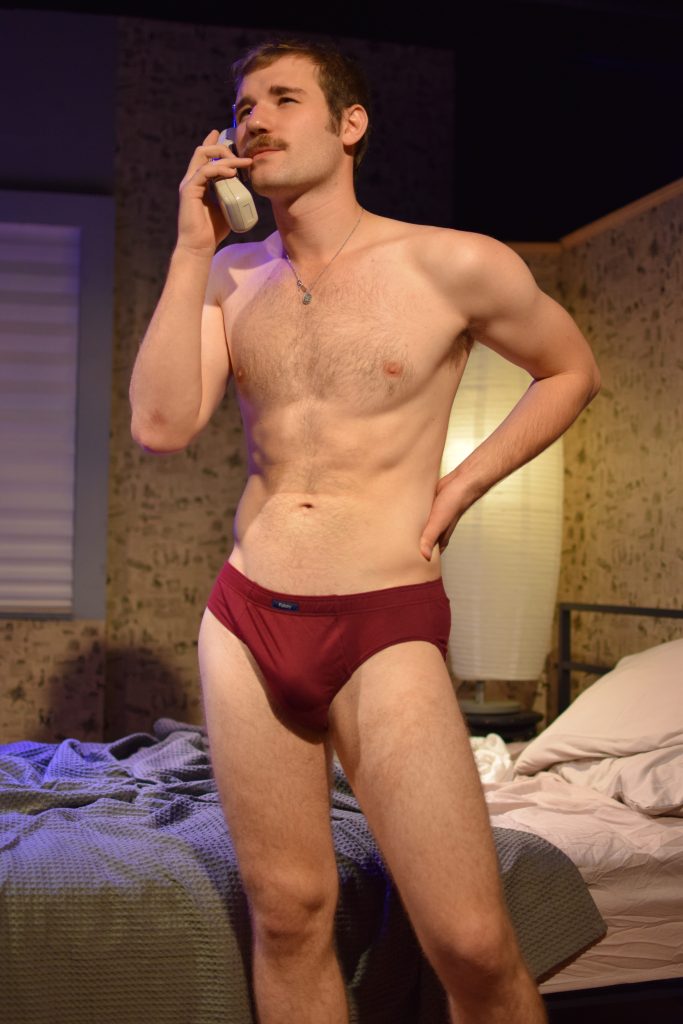
You’ve built a compelling screen resume with short films like SHEEP, The Last Hour (directed by John Biltcliffe), and A Man I Know (directed by Anca Radu). How does the tight, intimate lens of film acting compare to the raw, exposed energy required for live theatre in Jerker?
James: They are completely different beasts. In film, the camera does so much work for you. It can see your innermost thoughts, despite my best efforts to hide them! Theatre forces you to tackle the need to perform. It’s very easy, when standing in front of a hundred people (or in my case for Jerker, laying down), to pander to the audience and over do it. But that immediate feedback is wonderful – there is nothing quite like live theatre. That being said – the foundations are still the same, you do your work, you show up on time, you learn your lines, and you try your absolute hardest to find the real person that’s written between the lines. The task doesn’t change, but perhaps the approach to completing that task does.
Collaborating with directors like John Biltcliffe on The Last Hour and Anca Radu on A Man I Know must have shaped your approach as a performer. What lessons from those screen projects did you bring into the rehearsal room with Henry Adams for Jerker?
James: I’ll admit that during the times of shooting those short films I was trying to be seen as a ‘good actor’ which is the very enemy of any ‘good acting’. Looking back at those films I realise I was constantly aware about what others thought of my ability – and it didn’t help in the slightest. This being my professional stage debut, six years after I left school, has given me a long time to deal with the problems that I noticed in myself as an actor and to better learn my craft. The directors I’ve worked with have amazing directorial qualities – they know what they want, and they know how to get it from an actor. Knowing how to communicate with a director is a fundamental skill that I haven’t had much opportunity to foster, so I’m now getting a taste of what that relationship can look like, in all its many forms, and it’s fantastic.
Alongside acting, you’re actively developing original stage material focused on bold, character-driven stories about complex human relationships. What kind of themes are you exploring in your own work?
James: I’ve always been drawn to material that has a strong emphasis on character, they make us reflect on ourselves, often without us realising it. Without giving too much away – my current project revolves around a sex worker and how a pre-existing relationship of his shifts when it becomes transactional. I like seeing power shifts and the ebbs and flows of that power shifting back and forth. I try to steer away from making any obvious commentary on the world and focus on just telling a compelling, human story – this could be my actor brain seeping into my role as a writer – not wanting to place a pre-judgement on the characters, or their situations, as we are all as complex as each other and to label a character as good or bad from the offset is not only useless, it’s destructive as it limits our ability to understand them. That being said – there are some innate evils – if I ever make a piece about technology, AI will be the enemy. It’s humans that drive our need for connection to one another, not a robot lecturing us on how to navigate our lives, and that’s all I’ll say about that…
Jerker is famously subtitled A Pornographic Elegy and features explicit phone sex, full vulnerability, and erotic intimacy. As an actor making your professional stage debut, what was it like reading that script for the first time—and how did you prepare to perform such explicit eroticism live?
James: I’ll take you back to when I got the audition request. As actors, we’re constantly submitting ourselves for multiple shows in the hope that someone, anyone, will take a risk and ask us to audition. A few weeks after submitting for the role, I received the tape request. I was in LA shooting an independent TV pilot, and I read the breakdown in front of the rest of the cast, only to be swiftly reminded of the importance of reading the small print: “This role contains full frontal nudity and self-simulated masturbation.”
We had a good giggle about it, and then I was faced with the rather more serious question: Do I actually want to get naked on stage? Thankfully, my mum’s best friend, Lynn, happened to be in LA at the same time. I owe a great deal to her for putting my mind at ease about the whole thing.
When I got the role and read the script for the first time, I was taken aback by just how unflinchingly and unapologetically sexual the first third of the play is. I recognised that I had a lot of work ahead of me, and if I’m honest, I didn’t immediately know how to approach it.
What ultimately shaped my approach, though, was the connection between the two men. Beneath all the explicitness, there are two people trying to find intimacy, connection and some kind of understanding of one another. I realised that if I could find the truth in that relationship, rather than approaching the play as a series of sexual moments, the eroticism would follow naturally. The sex wasn’t something I needed to add to the characters; it was already part of how they connected.
Preparing to play Bert required a lot of personal work. I had to find a way into his world that felt truthful, rather than simply trying to demonstrate or perform sexuality. I had to find out what Bert might get up to with his evenings, and let’s just say that a couple of men spent some nights with Bert. I won’t go into the details of that process, partly because it’s quite personal, but also because I don’t think explaining it would necessarily help anyone watching the play understand it any better. If they happen to be reading this, I can only apologise. Hi, my name’s James, not Bert, and I’m an actor. Thank you for your contribution to the arts.
The show is driven by two men fulfilling their deepest fantasies over the phone without touching or seeing each other. What is the secret to turning someone on—and keeping an audience utterly spellbound—using nothing but your voice?
James: My goal throughout the rehearsals was to try and turn Paul on as much as possible during those scenes, whether I succeeded or not is left unknown to me. I’m not sure what the trick is, or whether there is one, but I do know that people inherently like stories, and even more so when they are a part of them. The whole sense of role play as seen in the show is built around the idea of levelling the playing field – our characters don’t know each other, and so by eradicating all sense of self from the call and infusing it with this conjured fantasy allows my character to heighten the sense of play. That’s where using only my voice comes in handy, I get to raise the stakes without having to physically act on them. Having only my voice to use is a double edged sword – on one end I get to funnel all the physical energy into the voice and imagine that I’m reaching through the phone and stroking him – on the other end is the fact that I can’t touch or see him. And although the layout of the stage theoretically does allow us to see each other, he fades away for me – it’s as if he’s not there. So, I think the audience will be interested for as long as we are, if we both continue trying to reach each other through the phone, then they’ll be interested, as soon as we see each other as actors on stage then we will lose that tingling energy.
You and your co-star Paul Dennison spend the show sharing late-night, boundary-pushing intimate calls. How did you two break the ice in rehearsals to build the raw, uninhibited chemistry required for those dirty phone calls?
James: I hope he’ll agree with me when I say that Paul and I hit it off straight away. It never felt like there was any ice to break. I would also say the play is almost impossible to do if you’re constantly feeling uncomfortable, and thankfully, we both recognised that before our first rehearsal. Whilst I initially wanted to keep my distance from him, as Bert has never spoken to JR, I quickly realised that wasn’t how that was going to work, and decided to embrace the off stage connection – a friendship that I hope continues after the show.
In terms of finding the chemistry for the erotic phone calls, it’s safe to say we’re both obnoxiously flirty people so perhaps it just came naturally.
With descriptive sexual language, heat, and physical exposure written right into the piece, where do you draw the line between performance and real, uncensored vulnerability? How has working with intimacy director Alice Camarota helped you push those boundaries safely?
James: As an actor who usually likes to do things as real as possible (with the exception of having to murder a character, etc) I was initially skeptical to work with an intimacy director, I hadn’t done it before and was ignorant of the true role of their job. Alice was a saving grace, all my thoughts on intimacy directors have been completely subverted because of her, they are there to make it safe and make it still look and feel as real as possible. Alice is a true professional, her ability to navigate difficult scenes is truly something to be studied.
It’s important that actors should feel comfortable when tackling this sort of material otherwise it could all go horribly wrong. Finding where myself and the character meet on our desire for fantasy certainly helped with that a lot, but I could only go so far without Alice. I would say to any actor, if there is an opportunity to use an intimacy coordinator, use them – they understand staged intimacy far better than you do.
Jerker balances heat with profound heartbreak and tenderness. What do you hope gets the magazine’s readers and theatregoers racing the most—the steaminess of the fantasy, or the vulnerability of the connection?
James: I would say that it all ties into each other. There would be no tenderness without the juxtaposing heat, and that’s precisely why the show works so well. I hope that all the readers find the time to see this show – maybe they’ll love it, maybe they won’t, but they should give it a shot! It’s not a show that everyone can handle, and we fully understand that, sometimes it’s just too much for people who aren’t a part of that world. That’s understandable, but if people are willing to have their eyes opened to a different way of having sexual encounters and experiencing a different form of intimacy then this show is certainly for them.
Most people I’ve spoken to came for the steam, but were floored by the emotion behind it. We love that people are coming [to watch the show]. We don’t judge on why you want to see, we’re all only human after all! If you see us, expect a rollercoaster, not a one stop train. We have a laugh; we have a cry, and that’s what makes us human.