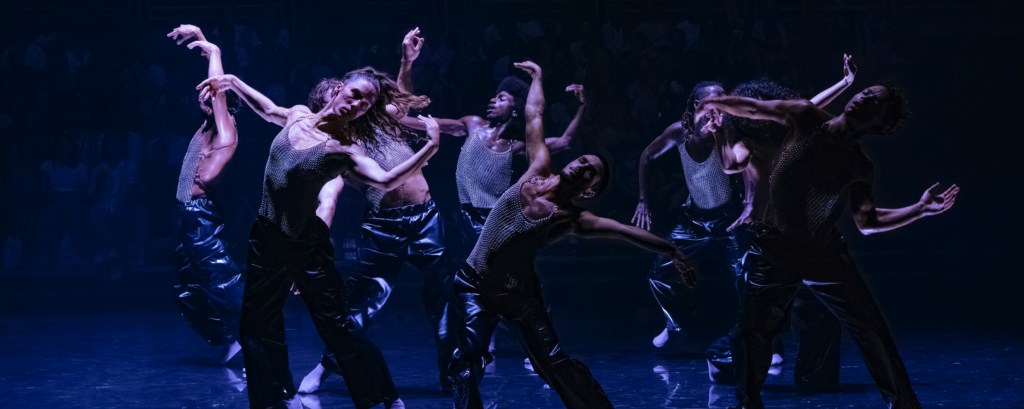
Portuguese choreographer Marco da Silva Ferreira makes his UK premiere of F*cking Future, a genre-crossing work which examines over-militarisation and toxic masculinity in contemporary society, challenging the patriarchal systems of power that shape bodies and behaviour.
The piece fuses house and techno aesthetics with contemporary dance to create a high-energy, physically demanding performance. Beginning at 60 bpm and accelerating beyond 240, the work builds a palpable sense of urgency before release. Blending military rigour with the freedom of club culture, the piece uses collective movement to imagine new forms of unity, resistance, and insurgency.
F*cking Future choreographs the friction between militancy and militarization, exploring and challenging the systems that shape bodies and behaviours. On a four-sided stage, and from within those very systems, a collective marches between rigidity and dissolution, discipline and desire, invoking new forms of union and insurgency.
Its intimidating approach reveals bodies that are MACHINE GUNS IN A STATE OF GRACE, piercing those who watch them like memories that cannot be forgotten. They sing with a disarming sensitivity and confront the future.
F*cking Future explicitly sets out to examine over-militarisation and toxic masculinity in contemporary society, challenging the patriarchal systems that shape our bodies. For a queer audience intimately familiar with navigating patriarchal pressures, how does your choreography visually strip away that rigidity on stage?*
This was a very carefully considered perspective from the very beginning of the process. The main objective was to create a macro-choreography in which organisation, discipline, metric precision and formation are gradually pierced by a micro-choreography where the individual, gesture, eroticism and sensitivity become increasingly prominent.
The idea was to use oppressive codes in order to subvert them.
This is achieved through the performers we chose, through the use of dance as a tool for liberation, as a friction against systems of productivity, and as a means of self-expression. The technological elements- music and lighting- are used to amplify a reflection that is initially invisible, one that seeks proximity and invites listening and looking, rather than provoking withdrawal through something imposing or aggressive.
The performance follows a group of dancers marching between “discipline and desire”. How do you map that psychological conflict onto the physical body, and how do the performers shift from the hyper-structured movements of a military body to a place of somatic liberation?
In general, personal conflicts are the main driving force behind my creations. I then go through a process of seeking plurality within those conflicts, which initially emerge as internal and personal experiences.
In this case, the relationship with club culture and techno music already contains, at its core, a connection to structures of power and its post-war origins. There was therefore a rich body of literature and artistic references where these relationships were already present.
In Fcking Future*, the conflict is never fully resolved. The problematic questions remain, and the tension and frustration are shared with, or even returned to the audience.
As performers, we all go through a study of structure and its mathematics in order to remain together and maintain control over it. Since I wanted to work from a logic of unclogging and release, what became important was a careful analysis of rhythm, fatigue, dramaturgical timing and their contrasts. This allowed us to shape a piece that gradually dismantles itself at a microscopic level, not only in the choreography, but also in the sound, the use of space, and the presentation layout.
The piece features a vocal landscape with layered chants like “WE BRING NO GUNS, ONLY BODIES ON FIRE”. In terms of queer and marginalised histories, how does the concept of utilising the “body on fire” serve as a weapon of ultimate protest when traditional power is stacked against you?
The piece does not take place in a concrete setting like a street, in a square, nor does it attempt to create that direct parallel. It exists within an abstract space, viewed in the round, which refracts whatever is placed within it.
Like a crystal on a board, a digital hologram, a museum artefact, or a mirage.
The metaphors within the work are extremely important. The bodies are on fire because they have overheated, yes, but also because fire is the light that makes them shimmer. It is the eroticism brought in to speak about non-normative, undocile bodies that pulse and bubble with vitality and hope for change.
It is a focus on the small power of the individual and their desire, and on the collective and the possibility of encounter.
You seamlessly fuse house and techno aesthetics with contemporary dance styles. For generations of LGBTQ+ individuals, nightlife and club culture have been spaces of chosen family and sanctuary. How does the piece honour the historical, insurgent power of the club dancefloor?
I found a place of self-expression and acceptance within club culture, in spaces where the rules were different from those of the outside world, where being together meant not being alone.
This cast is made up of queer dancers who are deeply connected to that culture and who understand the activism their bodies can embody when they stand together on stage.
The performance is a massive physical challenge that starts at 60 bpm and accelerates past 240 bpm before a final release. What is the psychological effect on the audience of building that kind of relentless, trance-like rave urgency in an auditorium?
More than placing the audience in a position of endurance, my focus is on communicating an idea and inviting people to listen.
Although the gaze and the discourse are directed towards the audience, they are not necessarily directed against them. I often tell the performers that perhaps we are saying these things and dancing this choreography in front of a mirror, like someone trying to find strength and convince themselves of what they believe.
This escalation is often described as kinaesthetic. It activates a desire to dance, to move, to contract along with us. The temporal, rhythmic and progressive scale of the work gradually brings the audience into our bodies during certain moments of the piece.
I did not want them to have much space to analyse or interrupt the flow while the work was declaring its intentions. I wanted to create a piece sustained by a single breath.
You draw strong parallels between military choreography and the collective movement found in nightlife. Where do you think the line blurs between a group of people raving together in ecstasy and a crowd assembling for a political rebellion?
This is a question with a very long answer. Academically, there are many works dedicated to this very topic.
Everything we do is political: what we listen to, where we gather, at what time; what we consume; how we love; what forms of intimacy we cultivate.
Questioning the place of pleasure, free time and undocile bodies within contemporary life is to lift the veil on productivity, labour, capitalism, control and power.
Asking why people feel the need to rave together in ecstasy or to assemble for political rebellion may help us understand the proximity between the two. Struggle does not always take the form of confrontation. Sometimes claiming joy, happiness, and testing intimate or sexual boundaries is also a way of questioning the future as a collective.
My objective with this work was not to create a theatrical imitation of either. We are not trying to stage a rave, a battle, a rebellion or a riot. The structure exists so that we can contrast it with details and sensitivities that need to surface and that inhabit the intersections of multiple questions, including this one.
After critical success globally, being named a 2025 Rose International Dance Prize finalist, and winning the CHANEL Next Prize, you are finally making the UK premiere of Fcking Future at Sadler’s Wells East. Why is London’s diverse and highly vibrant performing arts scene the right landscape for this work’s UK debut?*
I don’t know whether it is the perfect place for this work to be presented, but given the way the question is framed, I’ll choose to believe it might be.
It is difficult for me to imagine the work outside the context in which I live. It is impossible to know whether a work created from Portugal and from my own experience will be read in the same way in every theatre around the world.
I believe the context of each country changes the way people look. That is why I always say that the work speaks from a specific collective and from a particular position.
I always try to anticipate how it might be received and whether there are adjustments that could help the communication resonate more effectively; particularly in terms of interpretation and the performer-audience relationship.
London is a hyper-stimulating and queer city, living through a political moment marked by a nationalist turn (something we are seeing across Europe). We are immersed in an atmosphere shaped by fear around borders, control, hyper-surveillance, personal distance and virtuality.
I hope the piece can offer a breath of body, intimacy, affection and hope.
You’ve said regarding the urgency of this piece, “We dance because we cannot stop, because we can no longer stop.” For queer communities experiencing a global shift in socio-political pressures, how does that mindset of unstoppable movement echo the modern landscape of queer survival?
One of the greatest powers of increasingly oppressive politics is its ability to spread disbelief and apathy.
Giving in to that state is perhaps the greatest gift one can offer to socio-political regression, both for queer communities and beyond.
Dance has a remarkable power to reconnect us with our bodies. It is almost anti-capitalist in itself, an enormous expenditure of energy without any productive purpose apparently.
Socially, spaces of dance have often been spaces of activism and collective mobilisation, which I find deeply fascinating.
When the performance ends and the scent of “burnt perfume” lingers in the air, what is the core emotional realisation or conversation you want a queer audience member to leave the theatre carrying?
I see you. I hear you.
We move through the audience not to overwhelm them, but to draw along those who wish to join, and to show that queerness, when encountered up close, becomes far less frightening.
https://www.sadlerswells.com/whats-on/marco-da-silva-ferreira-fcking-future
 YASS Magazine