Few choreographers have understood the messy, breathtaking, and often agonizing beautiful chaos of human emotion quite like the legendary Pina Bausch. Her revolutionary Tanztheater style didn’t just change modern dance; it blew the doors open for radical vulnerability, subverting traditional gender roles and baring the raw mechanics of desire, fear, laughter, and pain on stage.
When Tanztheater Wuppertal brought Bausch’s penultimate masterpiece, Sweet Mambo, to Sadler’s Wells for its long-awaited London premiere earlier this season, audiences were treated to an absolute masterclass in expressionist storytelling. Against a backdrop of billowing white sheets and windswept, cinematic intensity, a tight-knit ensemble transformed tender, intimate moments into expansive, heart-wrenching theatrical spectacles.
At the center of this evocative world is Reginald Lefebvre, a longtime company member and a definitive Bausch collaborator. Reginald embodies the exact blend of hope, seduction, and absolute fury that makes Tanztheater so profoundly resonant to a queer sensibility—where identity isn’t just performed, but fiercely reclaimed. Fresh off the London stage, we sat down with Reginald to discuss the legacy of Pina Bausch, the bittersweet nature of Sweet Mambo, and how we communicate the deepest truths of our lives when words simply fail us.
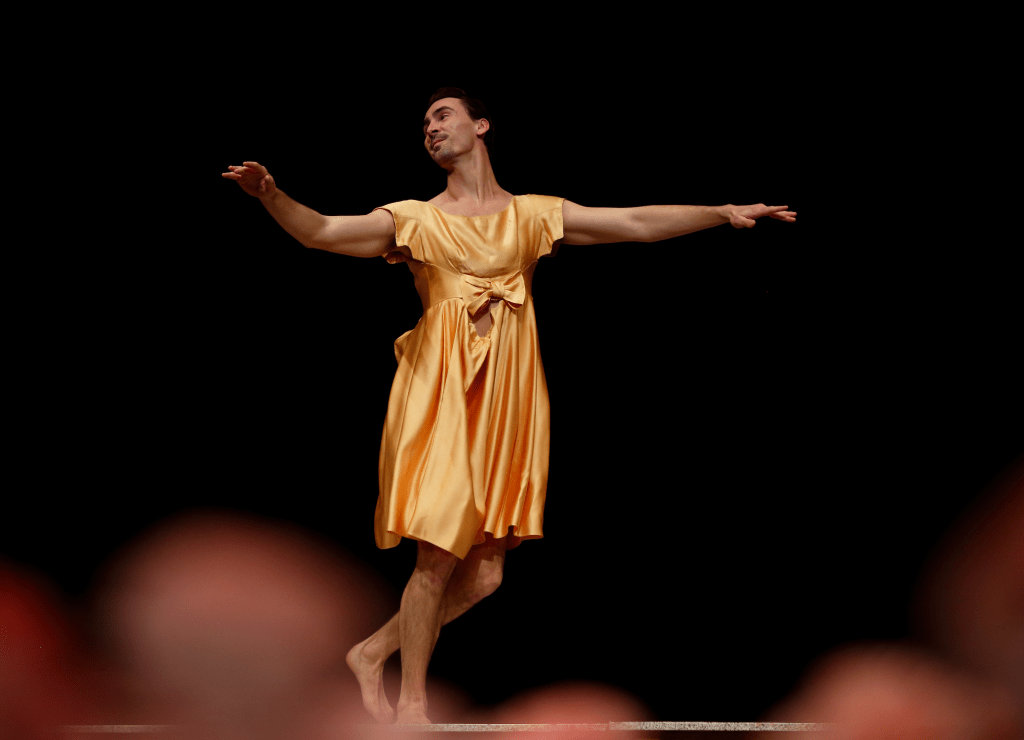
A piece by Pina Bausch
Reginald Lefebvre
(c) Laszlo Szito
‘Sweet Mambo’ was created in 2008, towards the end of Pina Bausch’s life. What does performing this piece today reveal about her artistic vision and emotional language?
Being one of the last pieces created by Pina Bausch, towards the end of her life, ‘Sweet Mambo’ seemingly presents a more minimal work in terms of scenography or number of dancers, yet still with much power and great emotional range.
Her artistic vision remains very true to herself: captivating emotional scenes, unpredictable laughter, scenes that mimic everyday life which make you then pause and reflect, beautiful solos that touch you to the core, and of course, amazing interpreters that blow your mind.
The work explores emotions like desire, fear, humour and vulnerability. How do you personally approach translating such complex emotions into movement on stage?
I would say what helps me to translate those emotions (whether it be into movement, text, or acting) is to confidently believe in them, which helps me to then own those scenes and allow my personality to shine through and not be afraid of drawing from my own experiences throughout my life. I would say that simply by copying or imitating an artist (or in this case, the original dancer who created the role) feels limiting in leading to great translations of emotions on stage.
Whenever I’ve had to learn the role of a dancer in the company, I needed to respect what has been created originally by getting as close as possible to what the dancer wanted to express, while simultaneously interpreting those emotions and translating them through my own personality and interpretation in order to make the scene believable and genuine.
Many dancers in the company were collaborators of Pina Bausch, and the choreography often incorporates performers’ personal experiences. How does that collaborative process continue today when performing her repertoire?
I’ve been fortunate to have had many opportunities to take over the roles of people who are still working in the company or are still living in Wuppertal, which is not always the case.
Because of these opportunities, I’ve gained access to extremely detailed knowledge: how the piece was created with Pina Bausch, why certain scenes were created, what the dancer wished to express, etc.
When learning a role, it is always nice to receive this information and sometimes even a funny anecdote to further understand the role and know fully what it is that I’ll be performing on stage.
The staging of ‘Sweet Mambo’ – with its flowing drapes and striking costumes – plays a powerful role in the storytelling. How does the physical environment shape the way you move and inhabit the piece?
The pieces of Pina Bausch make you dance in all types of crazy scenarios: earth, water, flowers, stones, wind, sand etc. These elements then of course shape and place conditions on how one will move during the piece.
Rehearsing in the studios on a normal dancefloor is a very different experience to moving to the stage with those incredible scenographies. It’s vital to adapt and rethink your way of moving, dancing, acting and being.
The same thing happens with the famously beautiful costumes that Pina loved to use in her pieces: dancing in a long beautiful gown will absolutely influence everything one will do while performing.
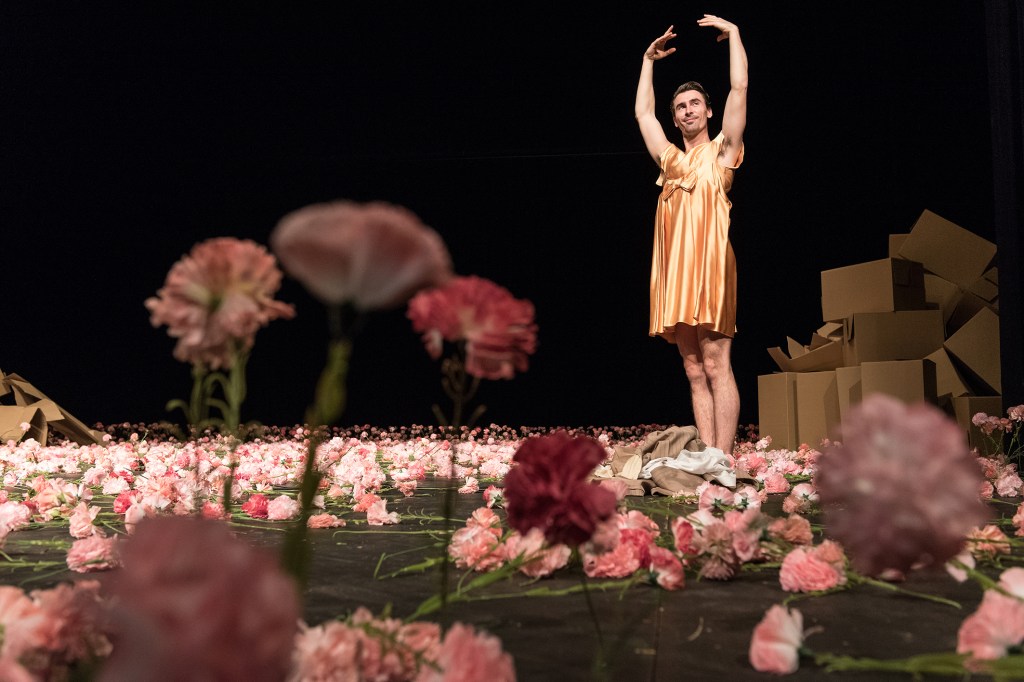
A piece by Pina Bausch
Reginald Lefebvre
(c) Karl-Heinz Krauskopf
Pina Bausch revolutionised dance by blending theatre, movement and spoken text into what became known as Tanztheater. How do you experience this hybrid language as a performer?
To me, it just makes the work richer and it’s thrilling to perform.
I love written text and theatre and I always have for as long as I can remember. So being able to perform many wonderful dances while then adding in theatrical elements or an eloquent or poignant text, I thought, why not?
Another challenge with our work at Tanztheater Wuppertal has been that Pina always wished for the dancers to try and speak the native language of the country where the company was performing in order to invite and welcome the audience even more.
As a dancer in the company today, how do you balance honouring Pina Bausch’s legacy with bringing your own individuality and contemporary perspective to the work?
Basically, with a tremendous amount of respect, care and love.
I do believe her work is timeless and her pieces will continue to last and be relevant because of their pure human essence.
As soon as you are passionate and respectful of something, it is possible to bring your own individuality and your own perspective into the work without bringing it to another place that deviates from its original intention.
We work tirelessly and are very well rehearsed with many of the original dancers that worked with Pina in order to find and maintain that balance.
The company’s repertoire has been performed around the world for decades. What do you think continues to resonate so strongly with audiences today?
Like I said before, I don’t feel that her work has fallen out of context in our society; on the contrary, it still feels extremely relevant today, which I find incredible.
The fact that she and her dancers were creating these works by drawing upon inspiration from real life experiences and individuals (moments/events or people witnessed on tours around the world, or in their day-to-day lives in Wuppertal) and then expressing this inspiration through unique personalities on stage just keeps the work so alluring and strong in 2026.
No matter how old the pieces are, audiences around the world still love them as much as when they were premiered, sometimes it seems even more! I also believe some pieces have gained even more relevance and are even more important to exist in our world today, more than when they were created. She was a truly visionary ahead of her time.
Contemporary dance is evolving rapidly, often crossing into film, digital media and performance art. How do you see the influence of Tanztheater shaping new forms of performance today?
The work of Pina Bausch has always been extremely visual, with powerfully moving images (complex or simple) and well-thought-out metaphors (either in dance and movement, or in theatrical scenes with texts).
Then the use of striking sets, tailor-made costumes of high quality fabrics and an eclectic range of music also help to inspire the many new forms of performance today.
Pina would also include other forms of art in her works to further elevate her pieces and bring more representation of this beautiful world to the stage: stunt performers, singers, trained actors, magicians, and many more.
Many young dancers are now navigating a more interdisciplinary creative landscape. What advice would you give to emerging performers who want to build a career in dance today?
To try to not just fit into a mold and follow along in common tendencies or trends. To be peculiar and unique, and unafraid of how others might see you, that would be the best advice I could give.
It is a breath of fresh air to see someone allowing themselves to be authentically themselves, which can be difficult nowadays because we have so much input to draw from, which shapes what we might think we need to do. In a society where we have constant access to everything through internet and social media, it is very easy to be influenced to just try and fit into what seems to be liked or in vogue, which of course still has its place. But as dancers, performers or choreographers, I’d advise to search and research what speaks to you, just be unapologetically yourself, and believe and trust in what makes you special and different. As artists, what I believe we should strive for, although it is a momentous task, is to do things that are innovative and have never been seen before. This pushes us beyond the limitations that we set ourselves, without sometimes even realizing.
Looking ahead, what do you hope the next generation of choreographers and dancers will bring to the art form – and how do you think companies like Tanztheater Wuppertal can contribute to shaping that future?
I hope they bring genuine work that took time to come from a place of true intention. I feel many artists today are pressured to produce and produce, which then over-saturates the art form. Pina took her time to create her works and worked endlessly even after her premieres to continue searching more for what she wanted to say. Great works of art take time and nowadays the world wants excellence immedialely, but true research needs time to develop into something wonderful. Take your time.

