Out in Oxford is a sharp and funny contemporary novel about middle-aged reinvention.
Returning to Oxford as a mature student, Russell pursues sex and love amid academic politics, online hook-ups and tangled friendships. As scandals unfold and relationships falter, he confronts the gap between instant gratification and genuine connection, learning that love, like education, is unfinished business.
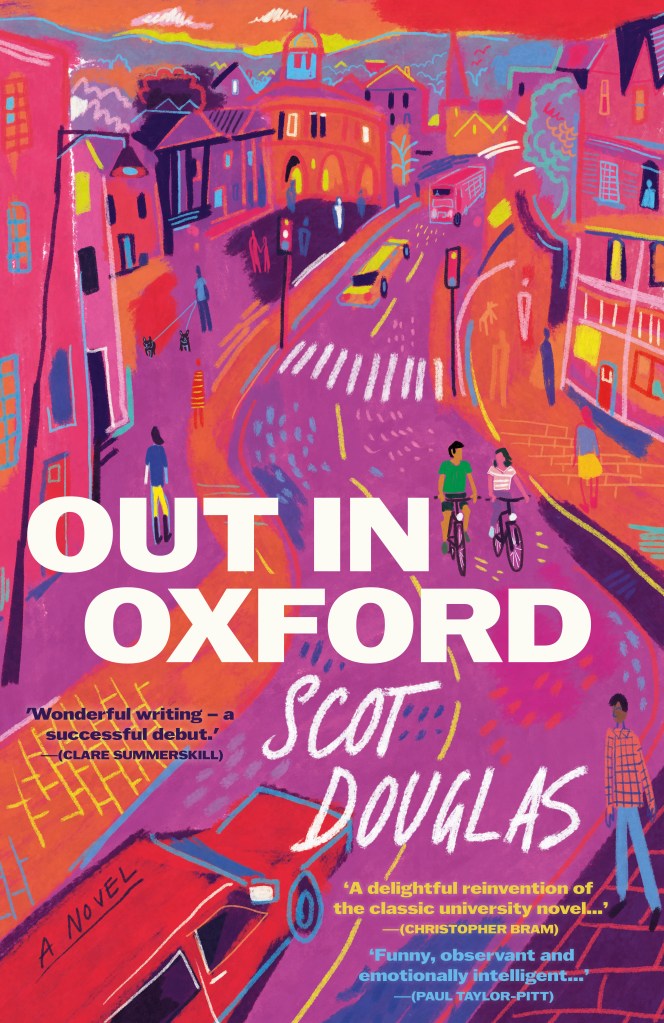
Out In Oxford is a witty take on midlife experience, blending campus satire with emotional honesty.
Scot Douglas’s debut novel Out in Oxford is the first in a trilogy exploring life and love in academia. He is a writer and researcher who has worked in a range of educational settings, from examining doctoral students at the University of Oxford to teaching six-year-old South Korean children in Seoul the lyrics to Raining in My Heart by Buddy Holly.
Scot explains: “Dedicated to Armistead Maupin, Out In Oxford is inspired by his Tales of diverse lives in San Francisco in the 1980s. Meeting him in London in 2024 was the catalyst for me to start writing fiction. His novels had helped me ‘find myself’ and enjoy the exploration of doing so. But as one reviewer of my book has said ‘what happens when we reach midlife and realise we haven’t yet finished becoming our true self?’ The quest is universal, reflected in praise for Out In Oxford by men and women, both gay and straight. The cast is disparate – all are after something they don’t have (love, sex, wealth, status). They think these will give their lives meaning. There’s humour in what they’ll do to find satisfaction and for some, their successes and failures are met with support by those closest to them. I want the novel to amuse but also to convey warmth in its message about the value of friendship.”
We had the joy to interview Scott and this is everything you need to know:
Queer narratives often focus on coming out in youth, but Out in Oxford spotlights a mature student navigating midlife reinvention. Why was it important for you to explore the idea that “becoming our true self” doesn’t stop after our twenties or thirties?
There are many great stories about coming out and these can be dramatic and make for excellent narratives, often providing comfort for readers and creating awareness of important issues. I wanted to focus on ‘what happens next’ after someone has accepted their sexuality. What is queer freedom supposed to become? Ben Fergusson in his endorsement of ‘Out In Oxford’ writes: “gay life in middle age is rarely addressed in contemporary fiction”. For me, having reached middle age (some time ago), I wanted to explore what becoming one’s true self might involve.
Russell navigates the contrast between instant gratification on apps and the search for lasting connection. From a midlife queer perspective, how has digital hook-up culture altered how gay men seek intimacy compared to earlier eras?
As an Education academic I can only write from my personal experience, not having researched gay culture. But it would seem to me that for many people, trying to meet a partner has changed because of dating sites and greater opportunities available online. Russell starts to live his sexual 20s in his 40s, which is wonderful in one sense, as he is free to hook-up and have fun, but satisfying his libido doesn’t necessarily further his wish to meet a partner. Perhaps, this conundrum was less experienced in a pre-digital age or at least experienced in a different way.

You dedicate the book to Armistead Maupin, whose Tales of the City provided a blueprint for a multi-generational queer community. How did meeting him in 2024 spark this story, and how does Oxford serve as your version of Barbary Lane?
I first read ‘Tales of the City’ in my 20s and the book opened up the possibility of living what I believed to be a full life. Straight and gay characters were often after the same things, with similar anxieties and dreams. Meeting Armistead was one of those moments where a world in my mind, one that I had imagined and craved, was suddenly in front of me. A lot has happened since reading his books but they offered solid ground on which to build hope, and I’ll always be thankful for that. Going back to being a student, Russell gives himself renewed hope. He is learning again, meeting new people and living without professional responsibility. He is determined to change and to try and live the full life he believes he is missing.
How does the concept of “found family” show up for Russell and his friends when their individual pursuits inevitably go off the rails?
For me, the value of friendship and a ‘found family’ comes with the opportunity to communicate, to share ideas and experiences and to listen to others. Those that do this in the novel have support available. They may not hear what they want, but they are always heard. Russell and Jane (his straight female equivalent) are forever hopeful they will find what they are looking for. They accept that mistakes are inevitable but their attachment to one another is durable, and this makes the quest worthwhile.
How do you balance writing an unapologetically queer story with themes of midlife identity that feel universal?
I do think that the quest to become our true selves is universal (reflected in praise for ‘Out In Oxford’ by men and women, both gay and straight). The cast of characters is disparate – they are all after something they don’t have (love, sex, wealth and or status). They think these will give their lives meaning. There’s humour in what they’ll do to find satisfaction and for some, their successes and failures are met with support by those closest to them. I want the novel to amuse but also to convey warmth in its message about the value of friendship and community.
You’re donating author profits to Queerwell, an LGBTQ+ mental health charity you co-founded. How do the mental health challenges explored in Out in Oxford—such as isolation, anxiety, and the pressure to perform—reflect the work Queerwell does nationally?
Queerwell (queerwell.org.uk) is an amazing charity. It is community-led, and community is at the heart of everything it does. Free and low-cost traditional therapies and creative workshops are offered face-to-face in London and Manchester, and their digital platform (Q-Time) is available to everyone: a live online space where you can join workshops, playshops, and discussions.
Your background spans examining Oxford doctoral students to teaching Buddy Holly lyrics in Seoul. How did your diverse background in education shape your observational style as a novelist?
One of the best things about teaching is the universal nature of the activity. I’ve worked with six to sixty years olds, and I’m constantly inspired by what can happen both in and out of the classroom. In schools, universities and summer camps at home and abroad (including teaching a Masters course in Athens) I’ve had the privilege of being with students and learning from them. Different experiences add richness to life and I hope my observational writing style reflects this.
Out in Oxford is the first entry in a planned trilogy. What can readers expect as Russell’s journey through life, love, and academia continues in the next installments?
A good friend says to Russell, “you’re a trier, Russ, and boy, does God love a trier”. Russell won’t give in and he is determined to make things happen. As far as he’s concerned, finding a partner is like his doctorate, ‘work in progress’. He may not succeed at first, but he’s going to enjoy the ride – and he does!
Find out more at https://bookguild.co.uk/bookshop/contemporary/out-in-oxford

