FAWN/MIKE, an original creation by French artist and singer AMAR, consists of two pieces choreography about queer identities in modern dance based on a queer love story about the archangel Saint Michael.
MIKE, the new creation that follows on FAWN and forms then a diptych wakes up in a wet damp, isolated street, where the music of a club next door is heard. MIKE is an unambitious character who likes to abuse substances, a penniless charmer who uses
his assets to obtain favours, an opportunistic seducer, a faint-hearted romantic. When he wakes up, he meets a stunned creature who invites him to dance and go back to the club, he was just kicked off of, with her. They spend the evening together, and through her contact he feels stronger and gains a certain confidence, and without knowing anything about this creature he ventures into the unknown and somewhat dangerous realms. Caught in the trap of his own adoration, he turns to religion to atone for his excesses, but the creature pursues him, confusing himself with his own reflection. To free himself, he chooses to confront it.

MIKE is about seduction and guilt, a quest for redemption and freedom. It alternates between jubilation and rebellion, devotion and extravagance, love and hate. It’s a creation for two dancers. It is a unique work, a choreographic proposition with several artistic vectors such as video, music and fashion. The body is a political object, but also an ambiguous, androgynous figure. These themes touch base with today’s clash between progress and regression, the future and the witch-hunts of social networking tribunals, and the oppression of minorities, the regression of women’s rights, the anti-LGBTQ+ movements.
FAWN
Sensibility, Love and Passion
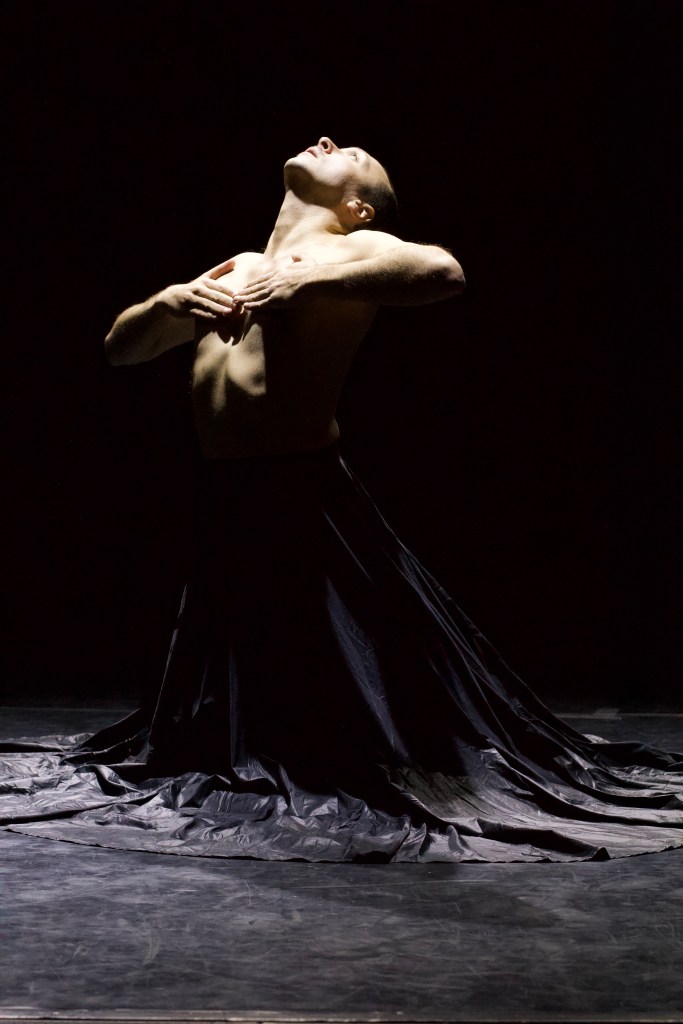
A choreographic reflection on the queer body and the HIV/AIDS epidemic, FAWN, the first part of the diptych, is inspired by Vaslav Nijinsky’s L’Après-midi d’un faune (1912). This reference is crucial to understanding the symbolic significance of the piece: Nijinsky, often perceived as an androgynous figure in classical ballet, was already blurring the lines between masculine and feminine in an era still marked by rigid conventions. The aim is to take up this ambiguity, transposing it to a contemporary setting, in the HIV/AIDS crisis, which has left its mark on an entire generation especially in New York City. The choice of setting the work between 1979 and 1985, the peak of the epidemic, reflects a desire to anchor the dance in a historical and political context.
The 1980s were a time when the LGBTQ+ community was struggling for recognition and survival in a political context that increasingly marginalized it. Dance thus becomes a means of articulating this collective experience in the same way as performance art, and centralizes the queer body. The notion of the body as both vulnerable and resistant is central to this creation. In FAWN, bodies are both spaces for the transmission of feelings and political objects, echoing the gender studies theories of the 1990s.
The notion of gender in FAWN pushes bodies into a revolt and a chase against the brutality of their destiny. The industrial setting depicted in FAWN – inspired by the photographs of Alvin Baltrop – reinforces the idea of a disused, dangerous environment, a reflection of the health crisis ravaging the city. The choreography unfolds between two contrasting spaces: the cold, dilapidated exterior of the docks, symbolizing isolation, and the interior of a nightclub, a metaphor for a secret life where the search for love and pleasure becomes a form of resistance.
The love triangle portrayed in FAWN oscillates between violence and seduction, in the image of these bodies in perpetual motion, exhausted by the struggle against illness but driven by an irrepressible desire to survive. The emotional charge of this work, nourished by dreamlike music and fluid gestures, combines romanticism and brutality.
FAWN exposes the fragility of human relationships in a context of urgency and loss of reference points, particularly in the suicide solo.
The aim is to infuse this piece with a romanticism tinged with naivety, contrasting with the harshness of the industrial setting, by creating a space where the quest for love is accompanied by a desire to transcend suffering, where two opposing forces meet: water and bitumen.
MIKE
Masculinity, Power and Domination.
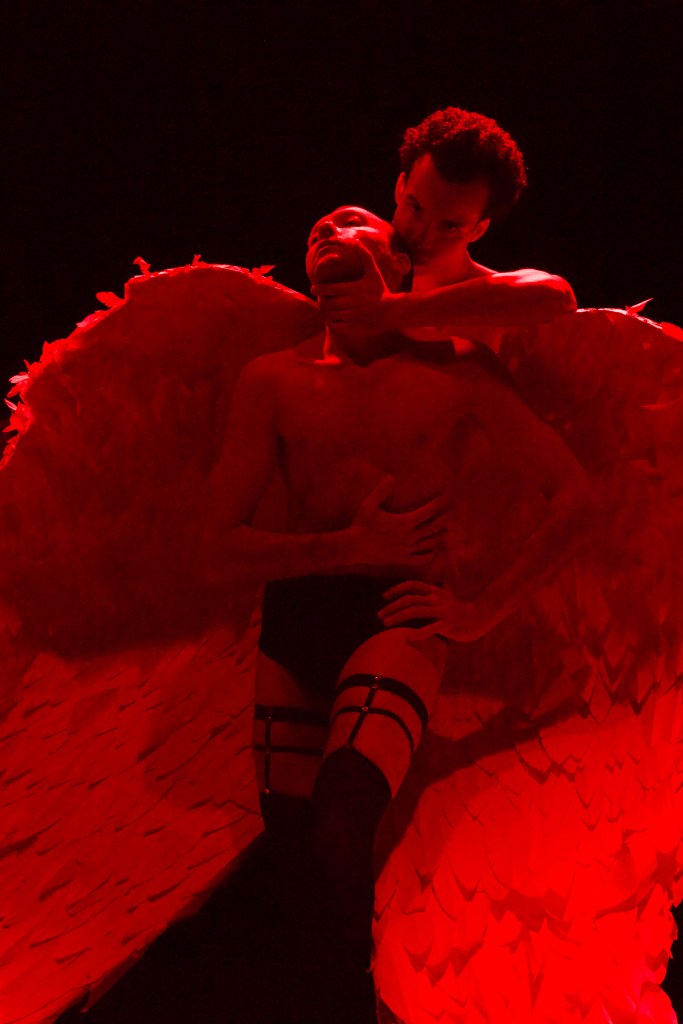
This second piece, MIKE, continues the reflection begun in FAWN on the queer figure, but focuses here on the notion of queer bromance and toxic relationship between two men.
The work is inspired by the mystical figure of St. Michael the Archangel, a complex symbolic reference to the idea of supremacy, in reference to the Book of Revelation. The figure of St. Michael the Archangel, often depicted as a warrior vanquishing evil, here it’s used to question the representation of masculinity in contemporary dance. The exploration of masculinity in MIKE is part of a theoretical framework that challenges traditional gender stereotypes, particularly in dance. In total contrast to the dreamy lightness of FAWN, where masculinity clashes with an eroticized form of femininity.
MIKE proposes a new form of choreographic dialogue between two dancers, where the masculine becomes fluid, and out of binary positions. On stage, the relationship between the two characters evolves into an almost toxic hold, where the balance of power constantly shifts and redefines itself. Here again, I use several artistic media – dance, music and video – to enrich the narrative and create a visual dialogue. This approach redefines the boundaries between movement, space and video. In my work, video and music amplify the tension between the two dancers, while theatricality adds a psychological dimension. MIKE’s choreography follows a path in which the two men, initially bound by a relationship of power, free each other. This long-theorized process of bodily emancipation demonstrates the body’s resistance to and submission to domination.
METAMARPHOSE is a diptych that questions queer identity, where the body is positioned as a political object and a tool of power. In this diptych, I question love, life and my own masculine identity. I’m inspired by the work of Nijinsky, Forsythe and Graham, and I also want to define my own choreographic boundaries.
AMAR is a queer artist based in Paris who explores the intersections between dance, music and queer culture. Trained in classical dance by Patrick Dupond before moving on to contemporary dance with Bino Sauitzvy, as well as Bharatanatyam under Sucheta Chapekar and Katia Légeret supervisions. This multi-faceted training, combining different practices, enabled him to develop a hybrid and contemporary choreographic vision.
At the same time, in New York, he turned his attention to the glam rock music scene, taking classes with Zvi Gotheiner at the New York City Center. Later, he took classes with Carine Damond, Maggie Boggaart and Fabrice Gibert.
AMAR stands out for his ability to fuse various artistic genres. His debut album, OTTO DISCO (2021), co-produced by artist NOSFELL, reflects a new wave influence, blending underground culture and eighties sounds. The single “Ready to Dance” became the soundtrack to the film La Première Marche, which recounts the first gay pride march in Seine Saint-Denis – France (Outplay).
He co-produced a remix album Ready To Dance Again with OKJAMES, before working on a second album WELCOME TO DEMOCRAZY (2022), co-produced with Tommy Marcus, a tribute to 90s queer culture. At the same time, AMAR is also making a name for himself invchoreography, with his first creation FAWN, composed by Jef Guillon, and MIKE, composed by Ferdinand Bydlowski.
AMAR is inspired by glam rock culture and aspects of the political and social context of his generation. Through music and choreography, AMAR creates performances that combine all his influences. He is an associate and co-founder in Celestine Production, a production company for queer artists, and co-founder of JOIGNY EN PRIDE, a non-profit organization that helps LGBTQ+ youth in rural areas.
Art director: AMAR
Dancer : Marvin Morand
Composition : Ferdinand Bydlowski
Videos: Daniel S.
Set designer : Christophe Simonnet
Lights : Arthur Pandraud
Costumes : AUX CORPS ANONYMES, Billie Genderfck
MUA : Theodora Elie
Assistante : Romane Perron
Exec producer: Cindy Chanfray
Photographer : Vinus
LINKS
IG : instagram.com/metamarphose
instagram.com/fawnmiketheballet
 YASS Magazine