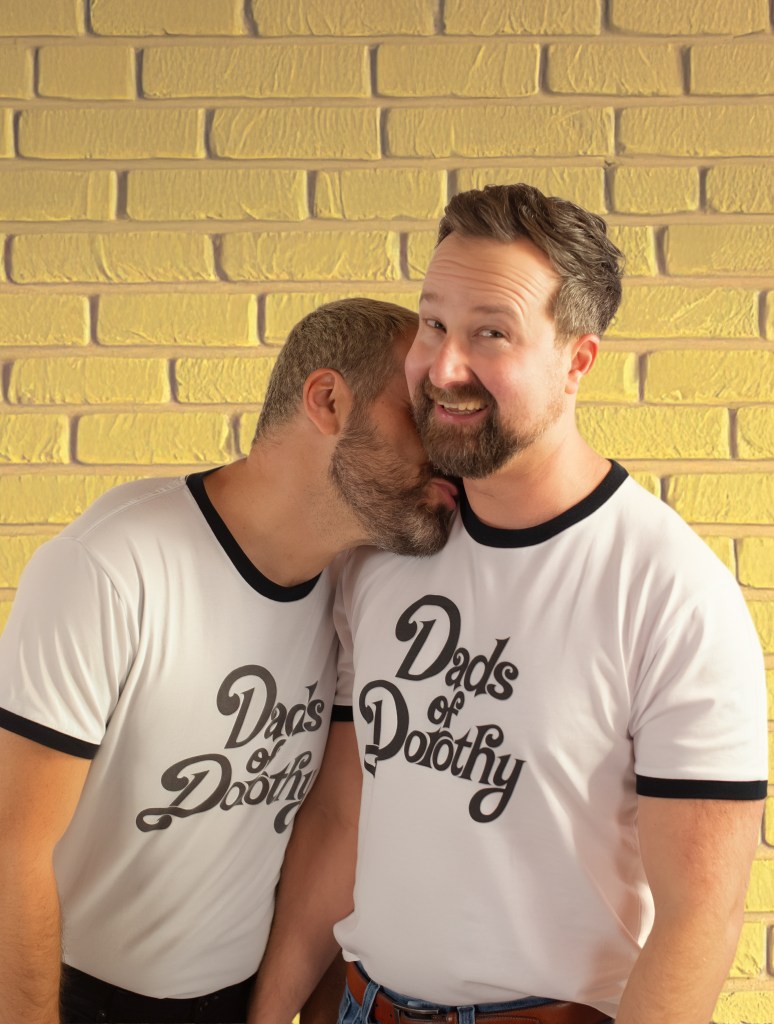
Gaddies, the queer dad–owned streetwear brand making waves across LGBTQ+ parenting spaces, is back with its most iconic drop yet: Dads of Dorothy — a playful, powerful reimagining of one of queer culture’s most coded phrases. Released in tandem with the global celebration of Wicked: For Good, the collection blends nostalgia, activism, fashion, and fatherhood into something unmistakably queer and beautifully current.

We sat down with the brand’s founder to talk legacy, dads, nostalgia, chosen family, and why Dorothy Gale still has the LGBTQ+ community by the heartstrings.
Dads of Dorothy is such a clever twist on a piece of queer history. What inspired you to take the old code phrase “Friends of Dorothy” and reimagine it for modern queer families?
Thanks! Our brand ethos is connecting the past with the present. Reimagining “friend of Dorothy” as Dads of Dorothy felt like a way to honor that legacy while celebrating how far we’ve come. Today, gay dads are no longer whispering in the shadows. We’re showing up at school pickup, on sidelines, at Pride — raising kids and raising visibility. It’s a wink to the past and a welcome mat for the present. And the fact that it resonates so strongly with queer families tells me it was the right idea at the right moment.
The Wizard of Oz and Wicked have always held deep resonance in queer culture. Why do you think this story — and Dorothy herself — still speaks so strongly to LGBTQ+ people today?
Queer people have always set the tone for culture — taking outside experiences and turning them into superpowers. Dorothy speaks to LGBTQ+ people because she shows what happens when you lead with heart, surround yourself with people who see your worth, and rewrite the rules of the world you’re handed. That’s the queer experience in a nutshell. And that’s why the story still feels so alive today.
You’re launching the collection alongside Wicked: For Good. How did that connection shape the timing and tone of the release?
Dads of Dorothy was one of the very first ideas I sketched out. It felt iconic from the jump — playful, historic, instantly recognizable. So when I heard Wicked: For Good was coming, it made perfect sense to hold the collection and ride that yellow-brick wave at the right moment.
Gaddies is proudly a queer dad–owned brand. How does your own experience of fatherhood influence the designs, messaging, and heart of what you create?
My experience as a father guides everything at Gaddies. I know what it’s like to not see my family represented, or to scan the zoo or museum hoping to spot another dad. I’m unapologetic about speaking directly to our community. I also know that gay dads are multi-dimensional — we’re more than just parents. I wanted an adult-first POV that focused on the dads.
“There’s no place like family” feels like a rallying cry for queer parents right now. What does chosen family mean to you — and how do you see that reflected in your customers?
“There’s no place like family” really is a rallying cry, because queer parenthood has always been built on chosen family. For me, chosen family means having people who get it without needing the backstory. The dads you text first when your kid won’t sleep, or the dads with older kids who’ve been there and lived to tell the tale.
I’m lucky to have an incredible group of gay dads in my life — we jokingly call our meetups “gaycare.” It’s therapeutic. No code-switching, no softening who we are. Just parents showing up for each other and our kids. Those dads shape my family as much as I do.
What’s powerful is how deeply the brand resonates not just with dads who built their families alone or with a male partner, but with dads who had children with women. They tell me Gaddies gave them a space where their story fits too. Making room for every dad’s journey is core to what we do. Chosen family isn’t just who we love — it’s the community we actively create. And I see that reflected in every Gaddy who shows up.
The line combines streetwear, nostalgia, and activism. How do you strike that balance between fashion statement and cultural statement?
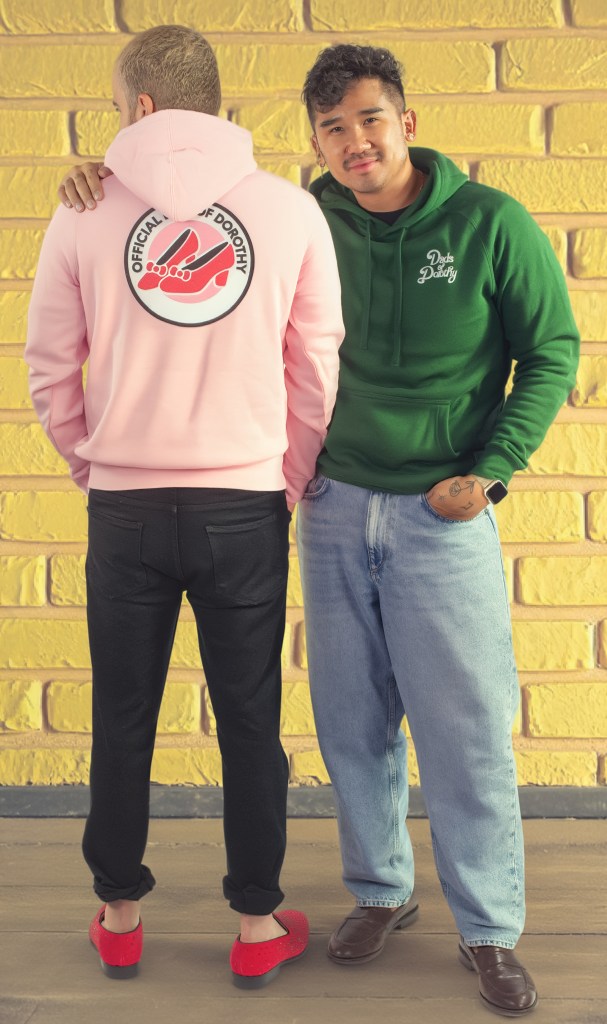
I think they’re one and the same. We start with pieces people actually want to wear: clean silhouettes, playful cultural nods, high-quality materials. Then we layer in the story. If the fashion is strong, the message hits even harder.
Clothes are political because they’re how we show identity to the world. Caught in a Dad Romance, Bottles n Biceps, Dads of Dorothy — they’re all ways we can celebrate and present ourselves with pride.
From premium tees to retro Dad Caps, there’s a strong sense of fun and confidence in this collection. What energy do you hope people feel when they wear Dads of Dorothy?
Fun and confident! Unapologetic and supported. When someone wears Gaddies, I want them to feel unmistakably seen — and a little unstoppable. Like, yes I’m gay and yes I’m a dad. It’s confidence with a wink. The best part has been hearing from dads who met each other because they spotted the hat. Those connections don’t happen without Gaddies, and that’s a humbling experience.
You’ve pledged a portion of proceeds to LGBTQ+ family-building initiatives. Why is giving back to that cause so personal for you?
My rights to exist as a gay dad are only here because of the work of so many who came before me — dads who couldn’t be dads at all, or who couldn’t be dads in the ways they wanted to be. Queer people who fought to make our families legal. It’s essential that Gaddies honors that and contributes to future families and generations.
The phrase “gay dad” used to be almost invisible in mainstream culture. How have you seen visibility — and perception — evolve in recent years?
Gay dads are not new; we’ve always existed. The phrase used to sit quietly at the margins, but now it’s spoken out loud, celebrated, and, most importantly, recognized as completely ordinary. I’ve watched queer parenthood shift from something whispered about to something proudly shared online, in books, in TV shows, at school pickup. Visibility hasn’t just increased — it’s matured. We’re no longer explaining our families; we’re defining them.
Finally, if Dorothy herself could see this collection, what do you think she’d say to the dads of today?
She’d click her heels, look at the dads of today, and say:
“Well, darlings… you didn’t just follow the yellow brick road — you repaved it.”
 YASS Magazine