Cypriot performer Elena Antoniou presents a bold and intimate solo that transforms the body into a living stage. With striking physicality and unapologetic presence, she explores how personal experience can become a shared space — a landscape shaped by desire, exposure and resistance.
Oscillating between pleasure and pain, LANDSCAPE invites us into a world where self-objectification becomes a radical act. Antoniou hypersexualises her form while holding space for trauma, teasing the edges of performance and provocation. The result is a dance that dares to confront the politics of looking — and being looked at.
Antoniou has presented her work across Europe, collaborating with renowned institutions including Onassis Stegi and the Marina Abramović Institute. Her practice spans choreography, performance and movement direction, and she continues to push boundaries with internationally acclaimed artist Maria Hassabi. With LANDSCAPE, she delivers a performance that is both deeply personal and defiantly political — a vital new voice on the contemporary dance stage.
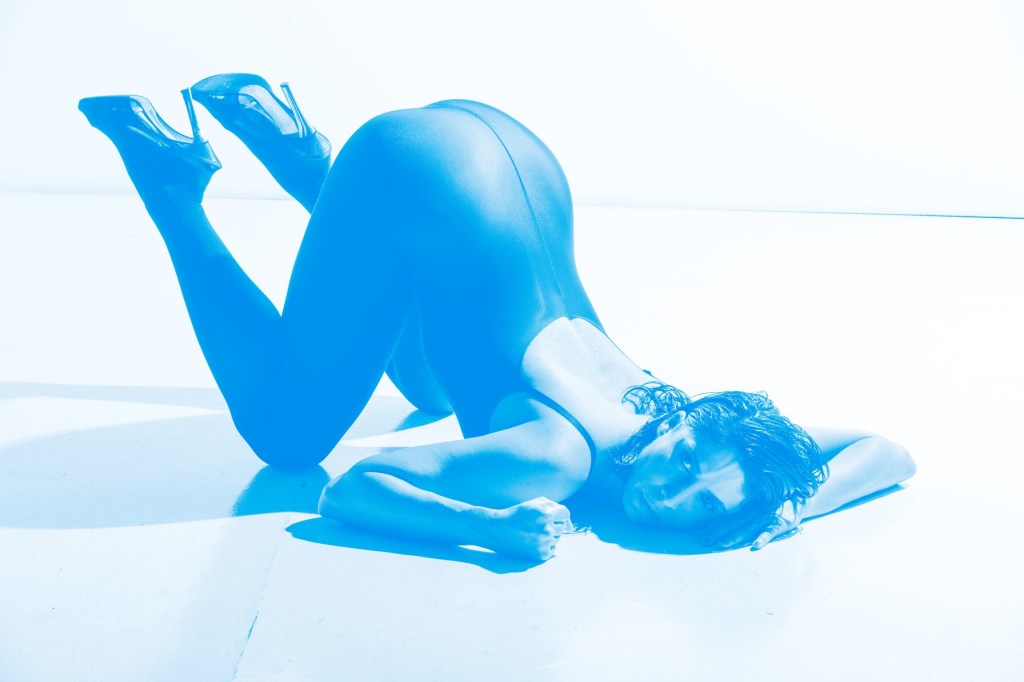
LANDSCAPE describes self-objectification as “a radical act.” Can you talk us through what it means to you to claim the body under that framework, especially as a queer or feminist subject?
A free body, in a free and just society, can — and has the right to — engage in self-objectification. It holds the right to transcend itself in whatever way it chooses. If our bodies were truly free to exist in any form they wished, that wouldn’t be a radical act. It would simply be a body exploring the limits of its own existence.
Within this context, I explore the boundaries of actions and images — gestures that might appear violent or torturous yet emerge as pleasurable, and others that seem pleasurable but conceal deep discomfort and pain.
The object-images I employ are recognizable and therefore accessible, inviting anyone to see and to experience them. Yet the crucial point is that I decide how far, how, and when self-objectification begins and ends. That agency is what renders the act radical.
Usually, others decide for us. But within LANDSCAPE, I remain sovereign over what happens to me. I have chosen to be the one seen — to invite all those gazes — on my own terms.
The performance oscillates between pleasure and pain. How do you choreograph or perform those turns between those states without either one overwhelming the other?
The balance between trauma and pleasure is never fixed; it shifts, following my here and now each time I perform. The truth is that even though I have performed LANDSCAPE several times, the memory of the trauma it engages with is not easy to carry. The fragility remains. But that is the work: exploring how the fragility of trauma can create space for pleasure.
The politics of the gaze is central in your work. How do you think your audiences’ identities (gender, sexuality, culture) might affect what they see in LANDSCAPE? Does the performance anticipate or invite particular kinds of spectatorship?
It is deeply interesting to observe how each audience perceives the work differently — how my gaze encounters, in turn, each local gaze and its history. The female and queer audiences experience the performance — and me within it — in another way. It is a different kind of connection, one that I assume emerges from shared experience or perhaps from shared trauma.
Yet the performance ultimately seeks to function as a mirror for anyone who witnesses it. The difference lies in the gaze. The spectators see a sexualized body — but in our work, it is the body that looks back at them. At the same time, they are aware that another spectator — perhaps a friend, a neighbor — is watching them as they watch this body, in a setting of full light where nothing and no one can hide. That is what generates the sense of unease, a discomfort that seems to recur almost everywhere.
Naturally, other emotions and responses arise as well — teary eyes, irony, neutrality. All of these reflect the attitude of society toward this body placed in the middle of a public square (or a theatre square).
As an artist, my aim is to reach that other gaze — the one uncorrupted by social stereotypes, collective trauma, violence, or abuse. A gaze capable of seeing a body simply as it is, and of appreciating the situation without filtering it through its own references.
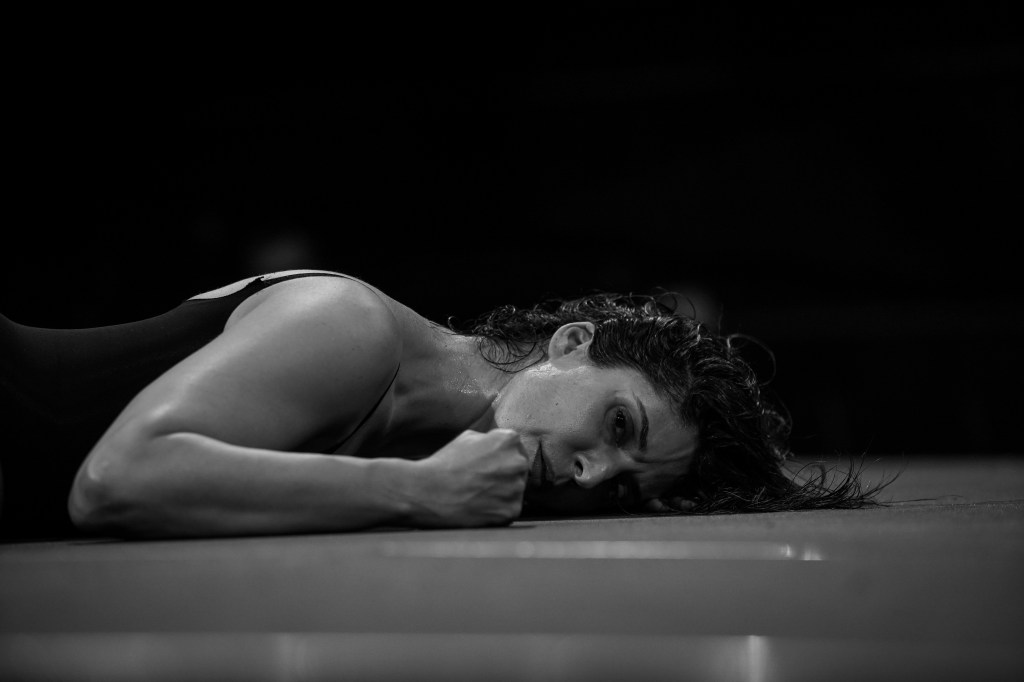
Hypersexualisation is often used (or weaponised) against women and queer people. How do you reclaim or re-shape hypersexuality in LANDSCAPE? Is it enough to push it to provocation, or are you seeking deeper transformation in how sexual bodies are perceived?
If we wanted to be provocative, I suppose I would perform naked. What we are doing instead is creating the conditions to expose the audience’s hypersexualization mindset. The entire setup — the lighting environment, the fact that the audience is allowed to take photos or videos — is part of a framework that enables them to reveal and project their own perceptions of the female body that stands before them: sexualized, yes, but also vulnerable.
Of course, I feed, ignite, and highlight all the actions and projections that each viewer directs toward me. I look straight into their camera lens while they film me on all fours. Yet all of this originates from the audience — I merely respond. The transformation you mention is both a political and a deeply personal act. What we offer is a ground, a first stimulus for someone to ask themselves: “How do I feel now, facing this body performing these gestures before me? How do I see this?”
For queer artists and audiences, the body is often a site of conflict, celebration, marginalisation. Were there specific experiences—personal, communal, political—that you felt needed to enter LANDSCAPE, as part of that discourse?
As a woman I have experienced all levels of sexism, aggression, devaluation, etc. This is not something new. It’s a discussion that feminists have been talking about since the 60s and the 70s. But now I feel that feminism is more inclusive. Patriarchy attacks femininity wherever it’s being spotted. On trans people, on gay people and of course women of color. I myself come from Cyprus, a small island in the mediterranean. Patriarchy and the male gaze are so deeply rooted in my country’s society that even we, as women, sometimes struggle to recognize them. We grew up with this lens, filtering everything through the male gaze, because that’s how we were raised.The idea of being a woman that can be explicitly sexual, looking straight in the eyes of the beholder and at the same time extremely vulnerable is what it’s all about. To be free to be anything without being judged as this and that but to be able to experience life as a multifaceted individual and not to play the parts that patriarchy asked from you.
The description of the work says that personal experience becomes shared space, that “landscape” is formed by desire, exposure, resistance. Could you say more about how you translate personal trauma or emotion into movement and spatial architecture on stage?
Let’s say that I’m exploring both physical and emotional limits. Long pauses, repetitive movements, giving full attention to a single action. Drawing from my experience in durational performance, I use this practice as an exercise and a tool — to make it real, to transform it, and to turn it into something else. I am interested in how time and duration reshape form and space. I work with daily movements, gestures, and images that the viewer can relate to — like a memory, something they have seen or experienced before. In all of this, the gaze is my most important element. All of this takes place on a platform positioned at the center of the space, elevated above the audience. The visual composition of the environment is therefore inseparable from the physicality that emerges — they were conceived and developed together throughout the creative process. It would be entirely different if I performed all this on a traditional stage while the audience sat quietly in their seats. Inevitably, the architecture of each venue becomes part of an architectural narrative — one that the audience has the opportunity to experience as a 360-degree encounter.
What do you hope queer people watching LANDSCAPE might take away, or feel — perhaps differently — from the performance compared to non-queer audiences?
Queer people, trans people, femmes, and women can relate to the wounded landscape. It is there that we meet and connect. I believe that when my gaze encounters these individuals, a different kind of connection and understanding emerges — both from them toward me and from me toward them. They know what it takes for someone to expose themselves in the way I do in that moment; they can recognize the journey and appreciate it, which is why they observe every movement of mine with such care and attention.They make up the majority of the audience willing to step close. It is as if they create a protective circle around me. I cannot know what each person takes away from the performance, nor do I wish to guide it. What I do know is that we have opened the doors and said: “Now you are free to move through this space as you wish, to engage with this body from near or far, to photograph or film it. The choice is entirely yours.” From that point on, each person takes responsibility for their own experience
In creating LANDSCAPE, has your relationship to your own body changed? Has performing it shifted what you feel about exposure, vulnerability, or control — in your life beyond the stage?
Returning to my own trauma renders me completely vulnerable, and as you can imagine, this is not something easily done. Yet this is, in essence, the work itself — a continuous exploration of how embracing the vulnerability that trauma evokes, as memory, ultimately creates space and a path toward pleasure. Through repeating the performance in such diverse locations, I have realized that the balance between trauma and pleasure is never the same. It shifts according to my own present moment. The LANDSCAPE — the terrain itself — matures with me. As I grow and evolve, so does it.
 YASS Magazine