The inaugural Rose International Dance Prize came to a close with an award ceremony hosted at Sadler’s Wells Theatre. Christos Papadopoulos has been named as the Rose Prize winner 2025 for his haunting production, LARSEN C. Named after the vast Antarctic ice sheet which broke away in 2017, Greek choreographer Christos Papadopoulos’ work explores the universal patterns of change and the monumental shifts occurring around the world.
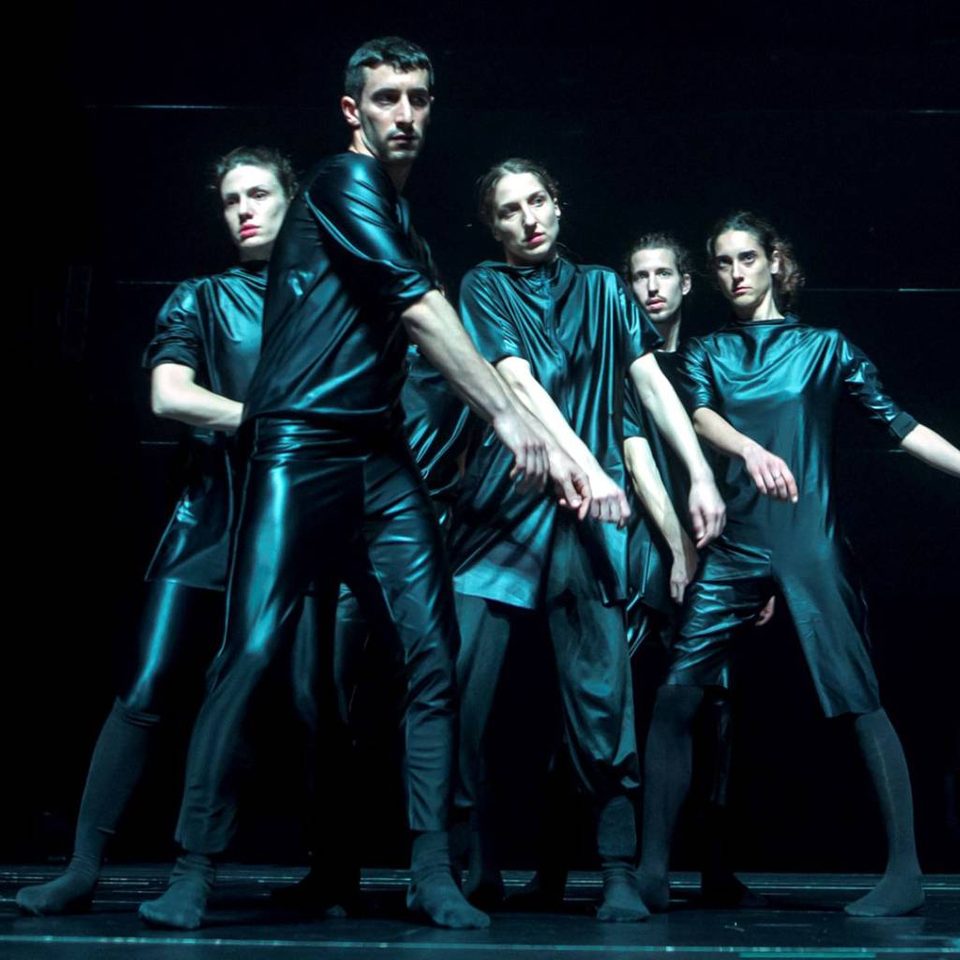
Stav Struz Boutrous has been awarded the Bloom Prize winner for Sepia, a solo piece that draws on her family’s Georgian roots, and reclaims a conventionally masculine dance, the traditional Georgian folk dance Khorumi. Stav Struz Boutrous contrasts this martial dance with feminine tenderness.
The productions were judged live by a jury featuring Dame Arlene Phillips, Karthika Naïr, Harvey and chaired by Professor Christopher Bannerman, who presented the winners with a trophy at this evening’s ceremony. On behalf of the jury, Professor Christopher Bannerman said: “We are delighted to be awarding these two prizes to Christos Papadopoulos and Stav Struz Boutrous. Over the last ten days we’ve seen such a wide range of visions, all realised to an exceptionally high standard, so we extend our congratulations to all those who presented work. Each of the seven choreographers represents not only a very distinctive voice, but comes from such distinctive contexts. It made the judging process unique, but also uniquely difficult.”
The judges also noted some commonality across the seven productions, recognising that these works emerged from the end of the global pandemic: ‘As a body of work, they offer a singular connection with the planet, the time we’re living in. They demonstrate how dance can resolutely engage with the world.’ Each work had to have premiered between October 2021 and July 2023 to be nominated for the prize.
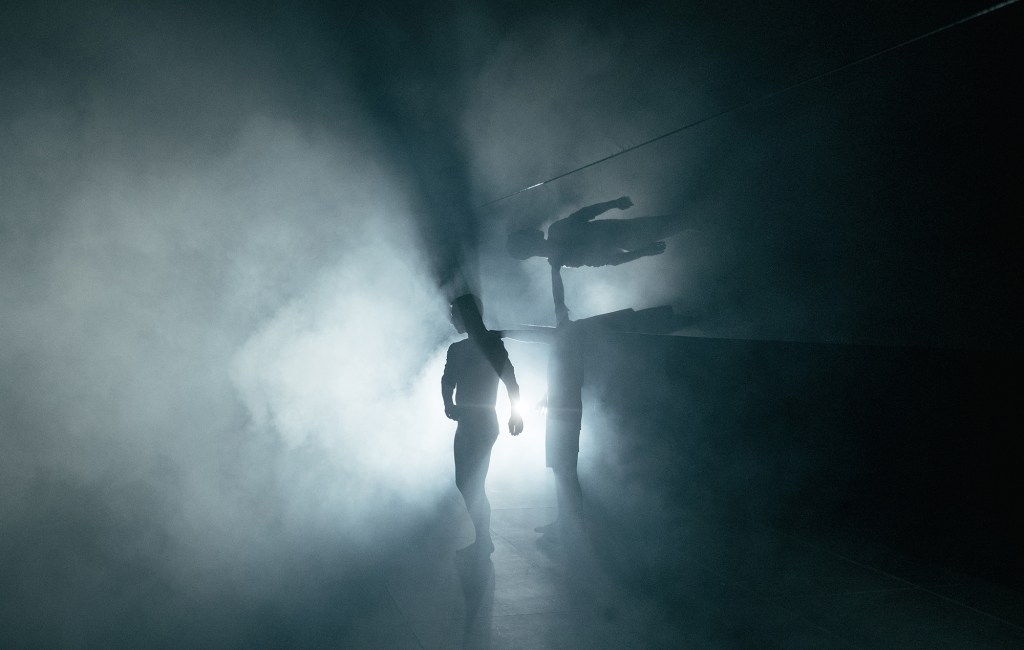
Christos Papadopoulos’s LARSEN C is a bold and meditative exploration of movement, time, and transformation. Named after the vast Antarctic ice shelf that is slowly breaking apart due to climate change, the piece mirrors the grandeur and inevitability of nature’s shifts through an intricate dance language that is both mesmerizing and hypnotic. It is a work that requires patience, but for those willing to surrender to its unique rhythm, it offers a deeply immersive experience.
From the very beginning, Papadopoulos establishes an atmosphere of quiet intensity. A single dancer appears in the dimly lit space, moving with an eerie fluidity that immediately sets the tone. Gradually, more performers emerge, their limbs undulating as if caught in unseen currents. The lighting design, by Eliza Alexandropoulou, is masterfully minimal, creating haunting silhouettes that give the impression of bodies floating in a void, disconnected from time and gravity. At certain moments, clever shadow play obscures the dancers’ lower bodies, leaving only torsos and arms in view, heightening the illusion of ethereal suspension.
The choreography is a study in precision and restraint. Instead of relying on virtuosic displays of athleticism, Papadopoulos crafts a language of subtle, continuous motion, where every ripple of a limb or shift of weight feels like a small yet monumental event. The dancers glide across the stage with an almost supernatural smoothness, their control and synchronicity nothing short of mesmerizing. Their movements oscillate between organic and mechanical, at times evoking the fluidity of ocean waves and at others the rigid articulations of puppets on invisible strings.
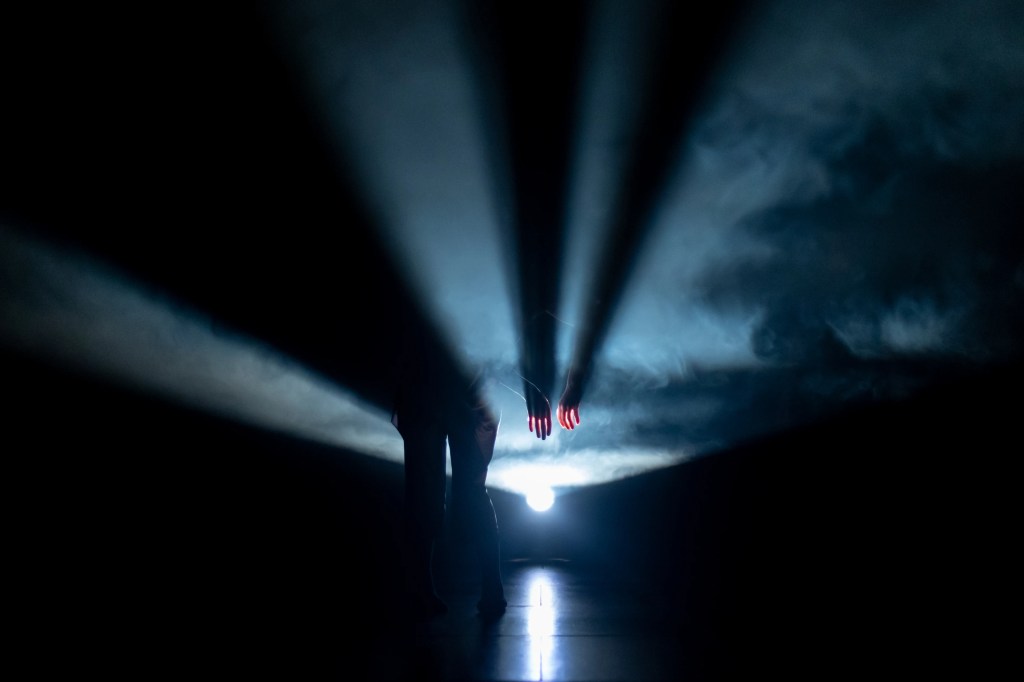
The soundscape, composed of electronic hums, distant echoes, and an eventual crescendo of gothic organ chords, deepens the sense of inevitability and transformation. It builds slowly, just like the movement, reinforcing the idea that change—whether in nature or in life—is often imperceptible until it becomes overwhelming. In the final moments, as the dancers coalesce and disperse in an ever-shifting formation, the work reaches its quiet yet profound conclusion, leaving a lingering sense of wonder.
While LARSEN C demands a shift in expectation from audiences accustomed to more conventional narrative or dynamic choreography, it rewards those who embrace its meditative quality. Its hypnotic repetition is not a flaw but an intentional device, inviting viewers to experience dance as something beyond spectacle—a living, breathing landscape of movement.
LARSEN C exemplifies the kind of bold, conceptual work that pushes the boundaries of contemporary dance. Papadopoulos and his exceptional cast have crafted an experience that resonates long after the final movement fades into darkness. It may not be for everyone, but for those open to its quiet power, LARSEN C is nothing short of mesmerizing—a dance of time, change, and breathtaking precision.
 YASS Magazine