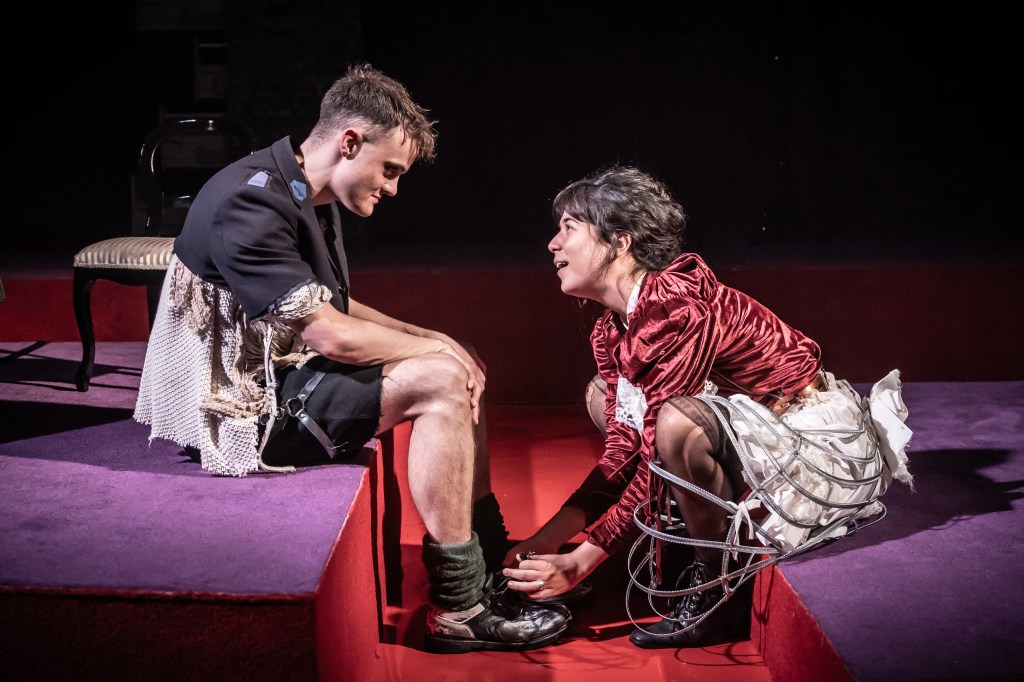
Class, crisis, cover-ups, and the crown feature in The Flea, a retelling of the Cleveland Street scandal which shook the country in 1889.
The Flea is directed by The Yard’s Founder and Artistic Director, Jay Miller and was about to run from 11 October to 18 November, but due to popular demand, The Flea has extended its run and will now end on 2 December. The cast includes Connor Finch, Scott Karim, Norah Lopez Holden, Séamus McLean Ross and Sonny Poon Tip.

Now a largely forgotten episode in London and LGBTQ+ history, the Cleveland Street scandal rocked the nation when a homosexual male brothel in Fitzrovia was discovered by police. At the time, sexual acts between men were illegal in Britain, and the brothel’s clients faced possible prosecution and certain levels of social rejection if discovered.
The government was accused of covering up aspects of the story to protect the names of aristocrats and other prominent patrons. It was rumoured that Prince Albert Victor, Queen Victoria’s grandson and second-in-line to the British throne, had visited. The police acquired testimonies that Lord Arthur Somerset, an equerry to the Prince of Wales, was a patron but both he and the brothel keeper, Charles Hammond, managed to flee abroad before a prosecution could be brought.
Although no clients were ever prosecuted, the male prostitutes, who also worked as telegraph messenger boys for the General Post Office were unable to rely on the same network of protection as their upper-class patrons. In acts that echo throughout the ages, they were tried by public opinion, humiliated in the press and given custodial sentences.
James Fritz is a playwright from South London. His plays for stage include Cashmoney Now (The Big House), Lava (Fifth Word/Soho Theatre), The Fall (National Youth Theatre/Southwark Playhouse), Parliament Square (Royal Exchange/Bush Theatre), Start Swimming (Young Vic), Ross & Rachel (Assembly/BAC/59E59), Four Minutes Twelve Seconds (Hampstead Theatre/Trafalgar Studios) and LINES (Rosemary Branch Theatre). Plays for audio include: The Test Batsman’s Room At The End Of The World, Dear Harry Kane, Eight Point Nine Nine, Death Of A Cosmonaut, Comment Is Free (all BBC Radio 4) and Skyscraper Lullaby (Audible Originals)

He has won the Critics Circle Theatre Award for Most Promising Playwright, the Bruntwood Prize for Playwriting, The Imison and Tinniswood BBC Audio Drama Awards and the ARIA Radio Academy Award for Best Drama on two separate occasions. He has also been nominated for the Olivier Award for Outstanding Achievement in an Affiliate Theatre and was runner-up in the 2013 Verity Bargate Award.
Director Jay Miller is the theatre director who founded The Yard Theatre and has been the driving force behind the organisation since its inception. Jay’s credits at The Yard have included This Beautiful Future by Rita Kalnejais (5* The Stage), The Crucible (5* The Sunday Times, Evening Standard) and Dirty Crusty by Clare Barron (5* Evening Standard).

We met the writer of the Flea and this everything you need to know.
How did you decide to write about the infamous Cleveland Street scandal?
The director Jay Miller asked me to go away and look at the underside of the late Victorian era, which is nowhere near as chaste and prudish as many people assume. It was a time full of scandal and controversy, and sexual exploration. I came across the Cleveland Street scandal in a book I was reading, and the more I dug into it the more I thought it might provide me with a great backdrop for a play. The scandal concerns a high-end gay brothel in Fitzrovia that was chanced upon by the police, when a young telegraph delivery boy admitted to working there. But what I was more interested in was the cover-up that followed – rumours were that the Royal Family were connected, and so only the working-class sex workers ended up being prosecuted. I often write about power and class dynamics and so this felt like such an interesting canvas.
How easy or difficult was it to write this play?
It was really difficult in some ways, and easy in others. Because it was based on historical events, it took a lot of research and alot of plot wrangling . But it’s also full of fascinating characters and thrilling moments, I loved the day-to-day writing of it. It’s definitely been the most fun I’ve ever had writing.
What parts did you find more challenging?
Finding the balance between being historically accurate and telling an exciting story. We’ve hopefully found a good middle ground. I hope it’s accurate in all the right ways. But anyone coming should absolutely not treat as the historical record! The play is playful, and very much ‘a story’, which hopefully is made clear. It’s part cop-drama, part-conspiracy thriller, part fucked-up episode of The Crown. Cleveland Street is an absolutely fascinating slice of history though – I’d encourage anyone who doesn’t know about it to do a deep dive into it.
How long did it take you to write this play?
That’s a tricky question to answer. The first meeting about it happened way back in 2018. I wrote one draft before Covid hit, but then we lost a couple of years. So really I’ve been working on it more intensely since about 2021 but beginning to end it’s been about five years which is probably my longest ever! It’s so nice to finally see it on the stage.

How relevant is this story nowadays? How has the gay culture changed?
I hope it’s relevant in loads of ways. For me there’s no point writing about the past unless you’re writing about the present in some way: the way in which our establishment looks out for itself, the way that shit rolls downhill in an aristocratic, class-based society, the way in which we shame and marginalise people in order to keep the boot on their necks. All of that still goes on today.The Flea is my attempt to take a ‘gods eye’ view of a scandal – to show the ripples of one telegraph boy being arrested from the very bottom of society to the very top.
The play is set in 1889 so obviously it’s a different world culturally, but it’s a fascinating and complex time in queer history. In 1885 a law was passed that created a new, very unspecific crime called ‘gross indecency’. Suddenly it became incredibly easy to prosecute homosexual men based on little more than hearsay. So all of a sudden there was this incredible climate of fear, which is why somewhere like Cleveland Street is set up and why its discovery causes such a scandal. A few years later, in part due to the public fallout from Cleveland Street, you had the trial of Oscar Wilde. There is probably a sequel to this play that someone should write that is even more interesting!
But I think it’s also important to note that The Flea only touches on some of this. At its heart it’s a story of a boy and his mother who get caught up in this series of political events they don’t understand. Like I said, I’d really encourage anyone who is interested to throw themselves into the wider history because it’s fascinating.
What shall we expect to see in The Flea?
It’s obviously a serious story, and at times a tragic one. But along the way we’ve tried to create something that is exciting and raucous with loads of twists and turns. It’s also got an incredible cast, and the costumes and design have to be seen to be believed. I watched a run through the other day – it’s funny and heartbreaking in equal measure, I hope.
Have we progressed enough as a society with regards to LGBTQ+ rights?
No. You only have to look at the transphobia that has come out of party conference season this month, the disgusting rhetoric that some of our lawmakers are using. There has been progress since 1889, of course there has. But ‘enough’? No.

You have won several awards and you have been nominated also in many prestigious award categories. Does this create more pressure on you for your next play?
To be honest I’m just happy to have another play on at this stage! I used to put loads of pressure on myself, but during Covid, when all the theatres closed and all my work dried up I started to think I might not make another play. So I’m just happy to be back doing what I love. I still hope people enjoy it, of course!
What are your next plans?
I’m writing a big series of radio plays for the BBC about the prison system, and finishing a new play for another theatre so hopefully it won’t be too long before I come back to the stage but you never know. So I’m gonna enjoy this one while it lasts!
 YASS Magazine